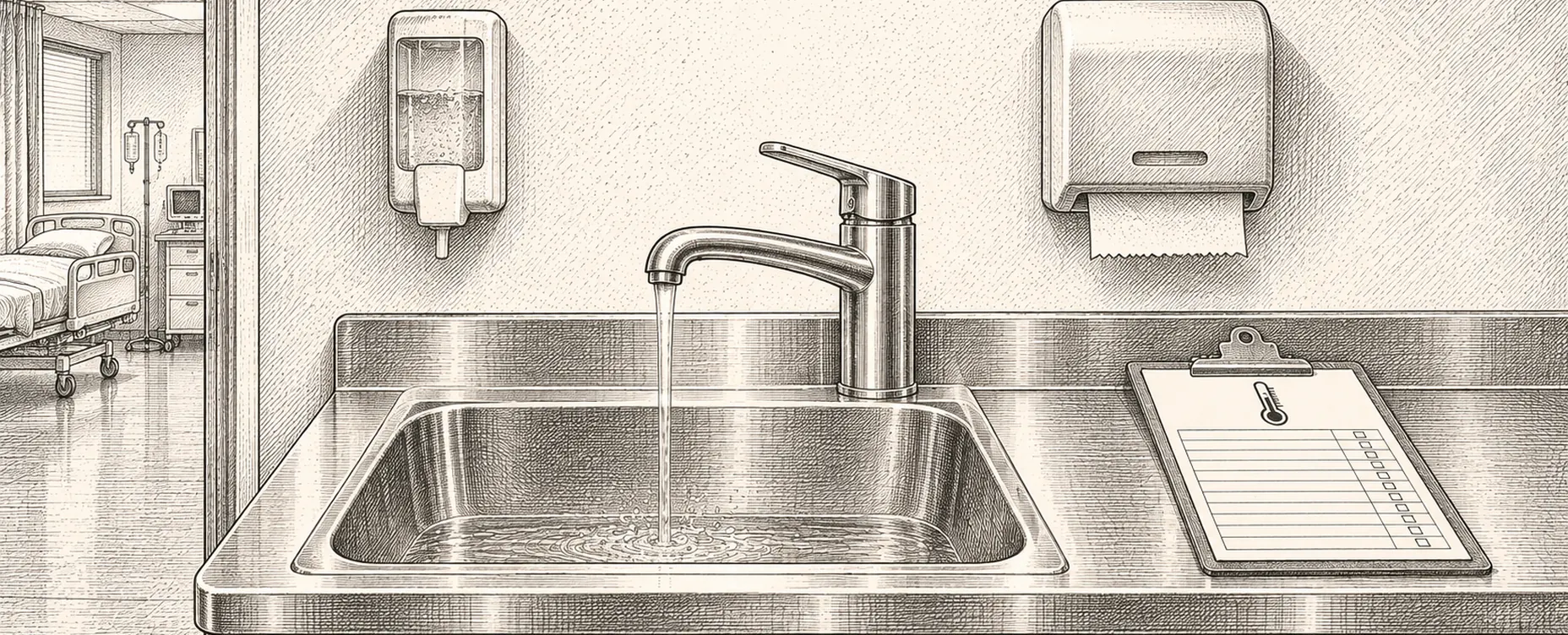
Water safety in a healthcare building is one of the few estates duties with a direct and well-documented patient safety consequence. Legionella bacteria multiply in water held at the wrong temperature, and in a hospital the people most exposed are also the most vulnerable to infection. The controls are unglamorous, largely mechanical, and heavily documented.
Monitoring does not change the policy or the responsibilities. What it changes is whether the evidence that the policy was followed exists, is complete, and can be produced on request — which in practice is where most water safety programmes struggle.
What the duty actually involves
The detail varies by country, and every healthcare organisation will have a water safety plan, a named responsible person and a water safety group. In outline, the framework requires a written risk assessment, a defined control scheme, a named accountable individual, routine monitoring at specified points, records kept for a defined period, and demonstrable action when readings fall outside limits.
The core temperature controls are broadly consistent: hot water stored hot enough to inhibit growth and distributed so that it reaches outlets quickly at temperature, cold water kept genuinely cold, and both measured at sentinel points on a schedule. The specific figures and intervals come from your national guidance and your own water safety plan, not from an article, and this is one place where using the wrong number is genuinely consequential.
Why manual monitoring is where programmes fail
The classic arrangement is a clipboard, a handheld thermometer and a monthly round of sentinel outlets. It is entirely valid and it fails in predictable ways.
It is a snapshot. A reading taken at eleven on a Tuesday says nothing about the same outlet at six on Sunday morning, when demand and therefore circulation are completely different.
It depends on somebody's time. When the estates team is short-staffed, rounds slip. The record then shows a gap, which is exactly what an inspection notices.
Transcription introduces error. Figures written on paper and typed up later are a well-known source of both mistakes and, occasionally, invention.
It cannot show trends. A distribution temperature drifting down over eight months is invisible in twelve monthly spot readings but obvious in continuous data.
Continuous logging addresses all four, and it does so without changing anybody's obligations.
What to instrument
Hot water generation and storage
Calorifier or cylinder flow and return temperatures, continuously. This is where the control regime starts, and a fault here affects everything downstream.
Distribution
Flow and return on each circulating loop. A return temperature falling away indicates poor circulation, which is one of the most common underlying causes of a system drifting out of specification.
Sentinel outlets
The nearest and furthest outlets on each loop, as defined in your water safety plan. Continuous monitoring here provides the evidence that outlets reach temperature quickly, at all times of day rather than at the moment of a visit.
Cold water
Storage tank and representative outlets. Cold water warming above specification is an under-appreciated risk, particularly where cold pipework runs through warm plant spaces or alongside hot pipes.
Little-used outlets
Rooms out of service, decommissioned bays, rarely used shower rooms. These are a recognised risk because water stagnates in dead legs, and they are also the hardest to remember on a manual round. Monitoring flow as well as temperature reveals whether flushing is genuinely happening.
Plant room conditions
Ambient temperature in spaces containing cold water pipework, plus leak detection. Cold water gaining heat in a hot plant room is a physical cause with an obvious remedy once you can see it.
Flushing: the task that most often lapses
Where outlets are little used, the control measure is regular flushing, and it is nearly always a manual task assigned to someone busy. It is the first thing to slip when a ward is short-staffed, and its absence is invisible until an audit.
Two things help substantially. Flow monitoring shows whether an outlet has actually been run, which converts a signed sheet into evidence. And automatic flushing devices exist for exactly this purpose in healthcare settings — they are specified equipment rather than a smart home project, and where a building has many low-use outlets they are frequently the right answer.
What monitoring adds is the ability to identify which outlets genuinely need it, rather than flushing everything on the same schedule regardless.
Sensor practicalities
Accuracy and calibration matter here. If logged data is going to support a compliance record, the sensors need appropriate accuracy and a calibration regime, with certificates. This is not the place for the cheapest available device, and it is worth discussing with your water safety group what standard they will accept.
Surface versus immersion. Clamp-on pipe sensors are non-invasive and easy to retrofit but measure pipe surface temperature, which lags and reads slightly low. Immersion probes in pockets are more accurate and require plumbing work. Which is acceptable depends on what the reading is being used for, and the water safety group should decide rather than the installer.
Range and environment. Plant rooms are hot, humid and noisy environments electrically. Choose equipment rated for it.
Infection control. Anything installed in a clinical area must be cleanable and must not obstruct cleaning. Consult infection prevention and control before, not after.
Reporting that is actually useful
The point of continuous data is not a wall of graphs. Three outputs earn their place.
Exception alerts when a monitored point falls outside its limits, routed to the estates rota with acknowledgement and escalation.
A monthly compliance report per sentinel point, in the format your water safety group wants, produced automatically. This is the output that saves the most time and is most valued.
Trend review, quarterly, looking for slow drift rather than breaches. Slow drift is what continuous monitoring uniquely reveals, and it is where preventive work gets identified.
Retention deserves a decision rather than a default: water safety records generally have a defined minimum retention period, so confirm it and make sure the system keeps data at least that long and can export it.
A sensible implementation
- Start with the water safety group, not with a supplier. Ask what evidence they need and what would make their reporting easier.
- Instrument generation and distribution first — calorifier flow and return, and each circulating loop. Highest diagnostic value, no clinical areas involved.
- Add plant room ambient and leak detection while you are there.
- Add sentinel outlets as agreed with the water safety group, with accuracy and calibration specified.
- Automate the monthly report in their format. This is what converts the project from a curiosity into something the organisation values.
- Then address low-use outlets, using flow data to target flushing and to build the case for automatic flushing equipment where it is justified.
The order puts the diagnostic and reporting benefit first, and keeps the parts touching clinical areas until after the system has proved itself. That sequence also happens to be the one most likely to get approved.