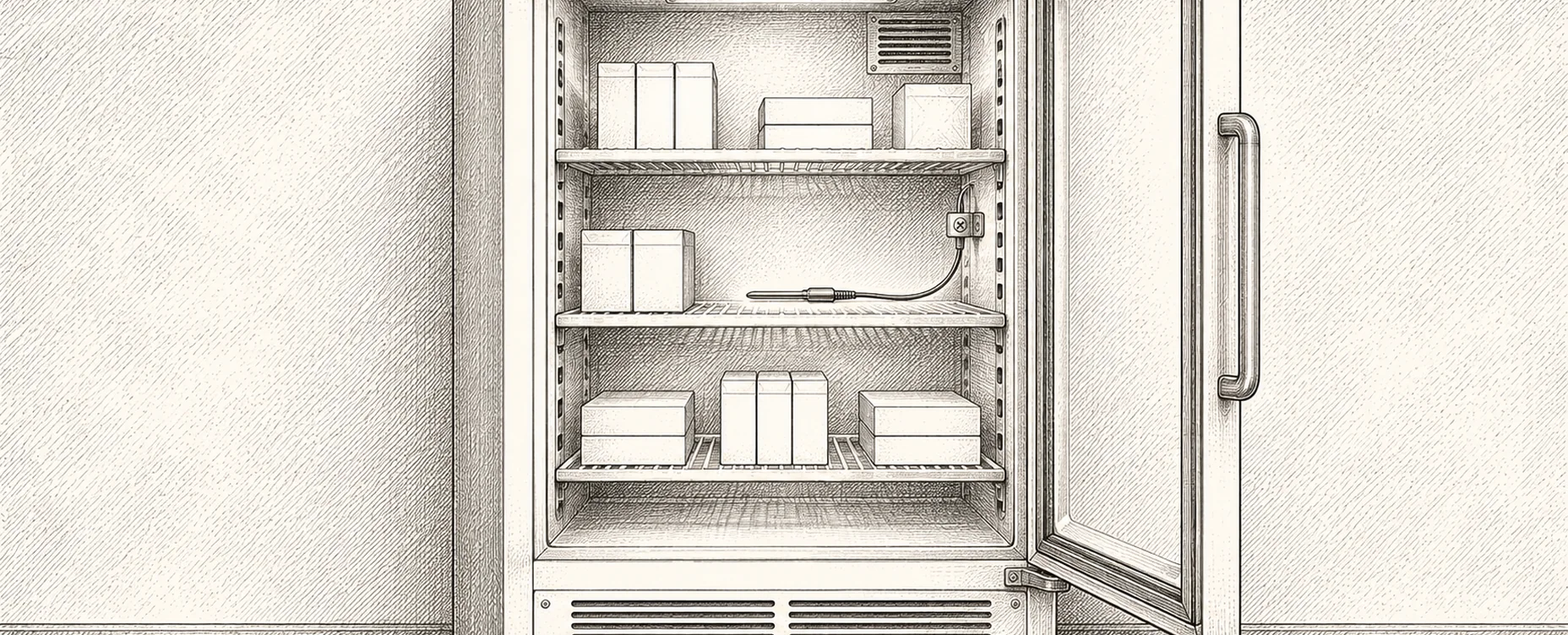
Temperature-controlled storage is one of the few places in a hospital where a few degrees of drift over a weekend translates directly into destroyed stock, cancelled procedures and, in the case of vaccines, a public health incident. It is also an area where the difference between a compliance-grade monitoring system and a consumer sensor is not a matter of taste.
This article tries to be precise about that difference, because getting it wrong in either direction is costly: using consumer kit where validation is required creates a governance failure, and buying validated systems for a staff kitchen fridge wastes money that could have monitored something else.
Two different categories of storage
Regulated storage
Medicines, vaccines, blood products, clinical specimens, reagents and anything with a defined storage specification that the organisation must demonstrate it has maintained.
These require monitoring that is calibrated, traceable, validated and auditable. In practice that means sensors with calibration certificates traceable to national standards, recalibration on a defined schedule, continuous recording with tamper-evident logs, alarms with documented escalation, and validation that the whole arrangement performs as intended — including mapping the storage space to find where the warmest and coldest points actually are.
Non-regulated storage
Staff kitchen fridges, catering cold rooms, linen and consumables stores, records archives, IT equipment rooms, and general estates storage.
Here ordinary building sensors are entirely appropriate, and frequently there is no monitoring at all today. This is where a modest investment produces immediate value.
The legitimate supplementary role
There is one honest use of ordinary sensors alongside regulated storage, and it should be described carefully.
A validated system records and alarms according to its specification. A supplementary sensor can provide an additional, earlier, differently-routed alert — for instance a notification to the estates on-call phone if a cold room door has been left open, or if ambient temperature in the room housing several fridges is climbing because the air conditioning has failed.
That is genuinely useful, because it catches the cause before the contents drift. Three conditions make it acceptable: it is agreed in advance with pharmacy or laboratory colleagues; it is documented explicitly as supplementary and not as the record; and it never replaces, silences or is relied upon instead of the validated alarm. Get that agreement in writing, because the distinction matters if anything ever goes wrong.
What actually causes cold chain failures
Understanding the failure modes tells you what to monitor. In practice the common causes are mundane.
Doors left open. Overwhelmingly the most common, and almost entirely preventable with a door contact and a prompt alert. A cold room door propped open during a delivery and forgotten is a classic.
Ambient conditions. A fridge in a room that reaches thirty degrees because cooling failed will struggle regardless of its own condition. Monitoring the room, not only the appliance, catches this early.
Power interruption. Including the interruption nobody notices: a socket switched off during cleaning, or a circuit tripped at the weekend.
Blocked airflow. Overloaded shelves and blocked vents cause internal variation that a single sensor in the wrong place will miss entirely — which is precisely why mapping is part of validation.
Equipment nearing end of life. Compressors degrade gradually. Trend data reveals a fridge working progressively harder months before it fails, which converts an emergency into a planned replacement.
Monitoring the room, which is squarely estates territory
This is the practical opportunity, and it sits comfortably on the non-clinical side of the boundary.
- Ambient temperature and humidity in every room containing temperature-controlled equipment.
- Door contacts on cold rooms and store rooms, with an alert after a few minutes open.
- Power monitoring on the circuits feeding critical appliances — a metering device that reports zero draw is reporting a problem.
- Leak detection beneath and around cold rooms and plant, since refrigeration fails wet.
- Airflow and condenser temperature where accessible, as an early indicator of degradation.
Every item there protects regulated storage without becoming its monitoring system, which is the distinction that makes this both useful and approvable.
Non-regulated storage worth instrumenting
Catering cold rooms and kitchen fridges carry food safety obligations of their own, and automated logging replaces manual temperature checks with a defensible record.
Records archives need stable humidity to prevent deterioration of paper, and a leak sensor because water and archives are a bad combination.
IT and comms rooms fail on temperature, and a hospital cannot tolerate an unplanned network outage. A temperature sensor and an alert is trivially cheap insurance.
Linen and consumables stores mainly need leak detection and a humidity reading.
Alerting that works at three in the morning
Cold chain problems have a short window and no respect for shifts, so the escalation design matters as much as the sensing.
Route to a rota, not a person. The estates on-call phone, or whichever role is genuinely awake and reachable.
Require acknowledgement, and escalate if it does not come. An unacknowledged alert must reach a second recipient within minutes.
Alert on the cause, not only the consequence. A door-open alert gives you twenty minutes to act. A temperature-excursion alert tells you the stock may already be compromised.
Monitor the monitoring. A sensor that has stopped reporting is an urgent maintenance item here, not an informational one. Silence must never be read as stability.
Test it quarterly, including overnight, and keep the records. This is the single most valuable habit in the article.
Who owns which alert
Cold chain sits across three teams and that is the usual source of confusion when something fails. Pharmacy or the laboratory owns the validated system and the stock. Estates owns the room, the power and the refrigeration plant. Catering owns food storage and its own food safety records.
Write down, for each monitored space, who receives the alert and who is expected to act. The common failure is an alert reaching estates about a fridge whose contents only pharmacy can assess, or reaching pharmacy about a cooling failure only estates can repair. Both need to know, in different terms and with different actions, and a single undifferentiated notification to a shared inbox achieves neither.
It is also worth agreeing in advance who decides whether stock is still usable after an excursion. That is a professional judgement with a documented process behind it, and it is not a decision that should be made at two in the morning by whoever happened to see the notification.
A defensible programme
- Find out what regulated storage exists and what monitoring it has. This is a pharmacy and laboratory conversation, and it may reveal gaps that need proper equipment rather than sensors.
- Instrument the rooms containing that storage — ambient temperature, door contacts, power, leak detection — and document it explicitly as supplementary.
- Instrument non-regulated storage, where you are free to use ordinary equipment and where nothing exists today.
- Set up escalation to a rota with acknowledgement and a second recipient.
- Review trend data monthly to find appliances working harder over time, and use it to plan replacement.
- Test and record quarterly.
The trend review in step five is the part most often skipped and the one with the best return. Turning an unplanned overnight failure into a scheduled weekday replacement is worth more than any alert.