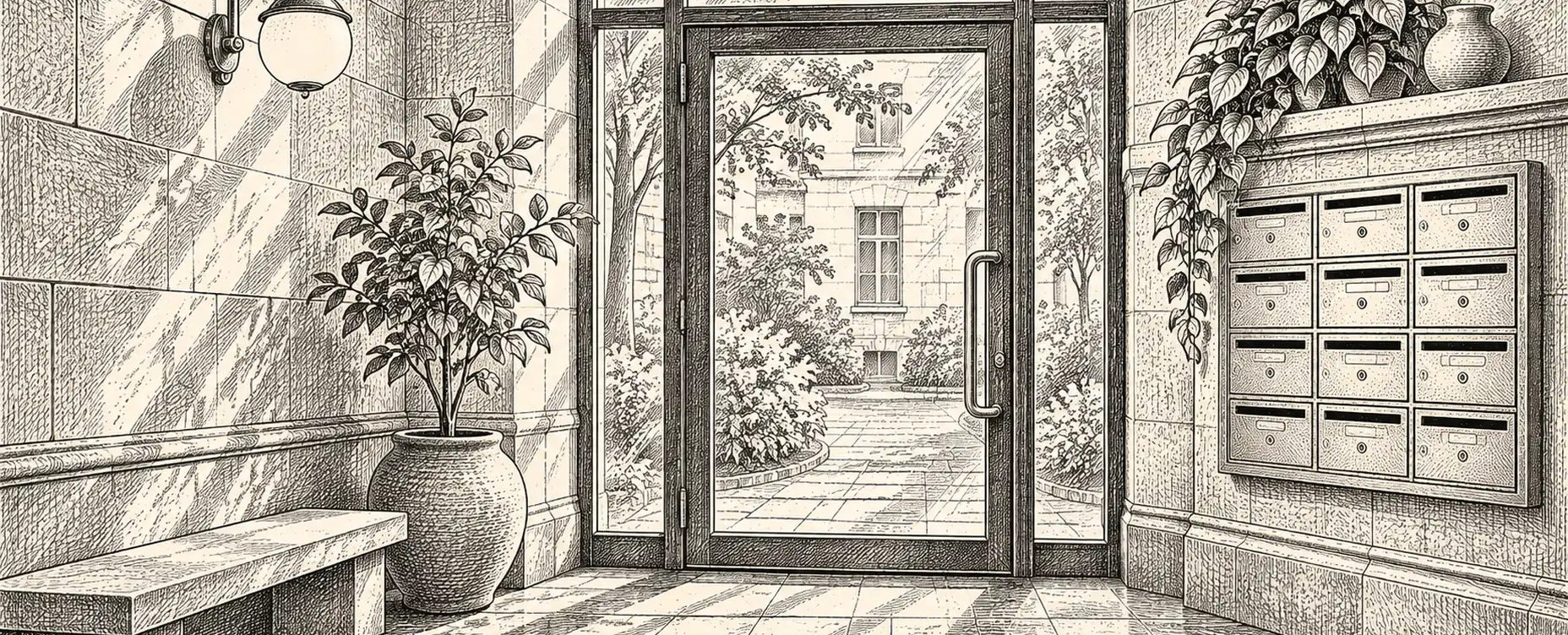
Almost every article about smart home access assumes a house with its own front door. A large share of Europeans live in flats, where the front door is shared, the entry system belongs to the building, the parcel problem is harder and the rules about what you may install are set by somebody else.
Here is what is actually possible, and how to get more done by asking rather than installing.
Know what is yours and what is not
The first and most important distinction, and the one that saves arguments.
Inside your flat is generally yours, subject to your lease and to not damaging the structure. Sensors, lights, thermostats and internal cameras are your business.
Your own front door is usually a grey area. It may be a fire door with a certified specification, in which case modifying the lock or fitting anything to it can invalidate its rating — a genuine safety and legal issue, not a technicality. Many leases treat the door as part of the common structure.
The communal entrance, hallway, stairs and lift are not yours. Fitting a camera, a sensor or a lock there without permission is likely a breach of your lease, and a camera in a shared hallway also raises data protection obligations because you are recording other residents.
The entry system belongs to the building and is usually maintained under a contract.
So the practical route is: do what you like inside, ask before touching the door, and treat everything communal as a conversation with the managing agent or the residents' association rather than a purchase.
Fire doors, which deserve their own warning
A flat entrance door in a multi-occupancy building is frequently a certified fire door, and its rating depends on the complete assembly — the leaf, the frame, the intumescent seals, the hinges, the closer and the ironmongery.
Consequences that surprise people: drilling for a new lock or a letterbox can breach the rating; a self-closing device must not be disabled, including by wedging it; and a lock must allow escape from inside without a key in most jurisdictions.
If you want a smart lock on a flat door, the honest advice is to ask the managing agent first and to prefer a retrofit thumbturn motor, which fits over the inside of the existing cylinder, requires no drilling, does not alter the door, and can be removed without trace. That single choice avoids most of the problem.
Video entry systems: what you can and cannot change
The panel at the street door and the handset in your flat are part of one system, and you cannot replace half of it.
What is often possible:
A call-forwarding module. Many modern systems can forward a door call to a phone app, sometimes as a building-wide upgrade and sometimes per flat. Worth asking the managing agent, because it may already be available and switched off.
A handset replacement compatible with the existing bus, which some manufacturers offer. This depends entirely on the system installed and is a question for the maintaining contractor, not a shop.
An intercom relay that detects the call signal in your flat and notifies your phone. These exist as retrofit devices and work with a range of systems. Two cautions: fitting one involves wiring into the building's system, which usually needs permission, and some can trigger the door release remotely — which is convenient and means you are opening a communal door for someone you cannot see. We would keep the notification and not the remote release.
A sound sensor as a crude fallback. If nothing else is possible, a sensor detecting your specific door buzzer and notifying your phone requires no modification at all. Inelegant and entirely within your rights.
What is generally not possible: replacing the street panel, adding your own camera to the communal door, or changing the access credentials for the building.
Parcels, which are worse in a flat
The last-metre problem is harder here, and honest answers matter more than clever ones.
Collection points and lockers are frequently the right answer in a flat, and there is no shame in that. Often free, always secure, and they remove the problem rather than managing it.
A communal locker bank is the real solution for a building, and it is a building decision. Raising it with the residents' association or the managing agent is more productive than any device you can buy — and in a building of forty flats the economics are usually reasonable.
A parcel box in your own demise, if you have a balcony, a porch or an allocated area, may be possible with permission.
Do not let couriers into the building. Buzzing in anyone who rings is how buildings get walked, and it is the commonest security failure in a block of flats. If a courier cannot reach your door, that is a delivery problem rather than a reason to open a communal door to a stranger.
Do not leave a note on the street door telling drivers a code or where to leave things.
Working with the building rather than around it
The measures with the biggest effect in a flat are building-level, which means they are a conversation.
Things worth proposing to a managing agent or a residents' meeting, roughly in order of how likely they are to be agreed:
Call forwarding on the existing entry system, which is often a software or module upgrade rather than a new installation.
Fob-based access with individual credentials rather than a shared code or a common key, so access can be revoked when someone moves out. This is the single biggest security improvement available to most blocks, and the current arrangement in many is a code that has not changed in years.
Communal parcel lockers.
Lighting on motion in stairwells and corridors, which saves real money on a communal electricity bill and is often an easy sell precisely because of that.
Leak detection in risers and plant rooms, which in a stacked building protects every flat below.
Cameras at the entrance, which is legitimate for the building to install with proper signage and a retention policy, and is not something an individual resident should do unilaterally.
A practical tip: proposals framed around cost, safety and insurance get agreed. Proposals framed around convenience or technology usually do not.
What you can do entirely within your own flat
Quite a lot, and none of it needs permission.
A retrofit thumbturn lock on your own door, if the lease permits, with codes for visitors and cleaners.
A contact sensor on your front door, which tells you it is closed and locked.
Notification of your buzzer, by whatever method is available.
Interlinked smoke and heat alarms inside the flat, with notification when you are out. In a block, knowing early matters more.
Leak sensors under the sink, behind appliances and by any cylinder. In a flat, a leak is not only your problem — it is the flat below, and it is the commonest source of neighbour disputes and insurance claims in apartment buildings.
Temperature and humidity sensors, since flats overheat readily and single-aspect flats often have ventilation and condensation problems.
Lighting, heating and everything else that lives inside your walls.
What we would do
- Read your lease on alterations and on the entrance door.
- Ask the managing agent whether call forwarding is available on the existing entry system.
- Use a retrofit thumbturn lock that does not alter the door, if you fit one at all.
- Never disable a door closer or modify a fire door.
- Use collection points rather than trying to solve deliveries at a communal door.
- Fit leak sensors, which protect your neighbours as well as you.
- Propose fob access and stairwell motion lighting to the building, framed as security and cost.
- Do not install anything in communal areas without written permission.
Items two and seven are where the leverage is. The best access improvements in a block of flats are agreed rather than bought, and most residents never ask.