Home delivery has become the normal way to buy things, and the last few metres remain unsolved. Parcels are left on doorsteps, behind bins, with neighbours who are out, or taken back to a depot because nobody answered a door they never heard.
A connected home genuinely helps here, and the useful interventions are more mundane than the products being marketed.
The four ways a delivery fails
Being precise about the failure mode tells you which fix is relevant.
Nobody heard the door. A doorbell that only rings a phone, a phone on silent, a household spread over three floors. The driver waits thirty seconds and leaves.
Nobody was in. The most common, and the one that needs somewhere for the parcel to go.
The parcel was left insecurely and got wet, or was taken.
The driver could not get to the door at all — a gate, a shared entrance, a flat with a broken entry system.
Notice that only the third is really a theft problem, and it is the one that gets the most marketing attention.
Being heard: the cheapest fix
A doorbell that reliably makes a noise inside the house solves more failed deliveries than anything else.
Do not rely on a phone. Phones are silenced, upstairs, or in a pocket during a call. A physical chime inside, or two in a larger house, is what actually works.
Announce on speakers if you have them, which covers a whole house.
Add a visual alert — a lamp flashing — for anyone hard of hearing, or for when music is playing.
Check the button is obvious. Drivers are in a hurry. A doorbell that looks like a decoration, is unlit at dusk, or sits behind a storm porch gets missed. A small illuminated ring and a sensible position matter more than any specification.
Answer quickly. Latency between press and notification decides whether you catch the driver, which is one of the reasons wired doorbells outperform battery ones.
Somewhere for the parcel to go
This is the actual solution to the actual problem, and it is unglamorous.
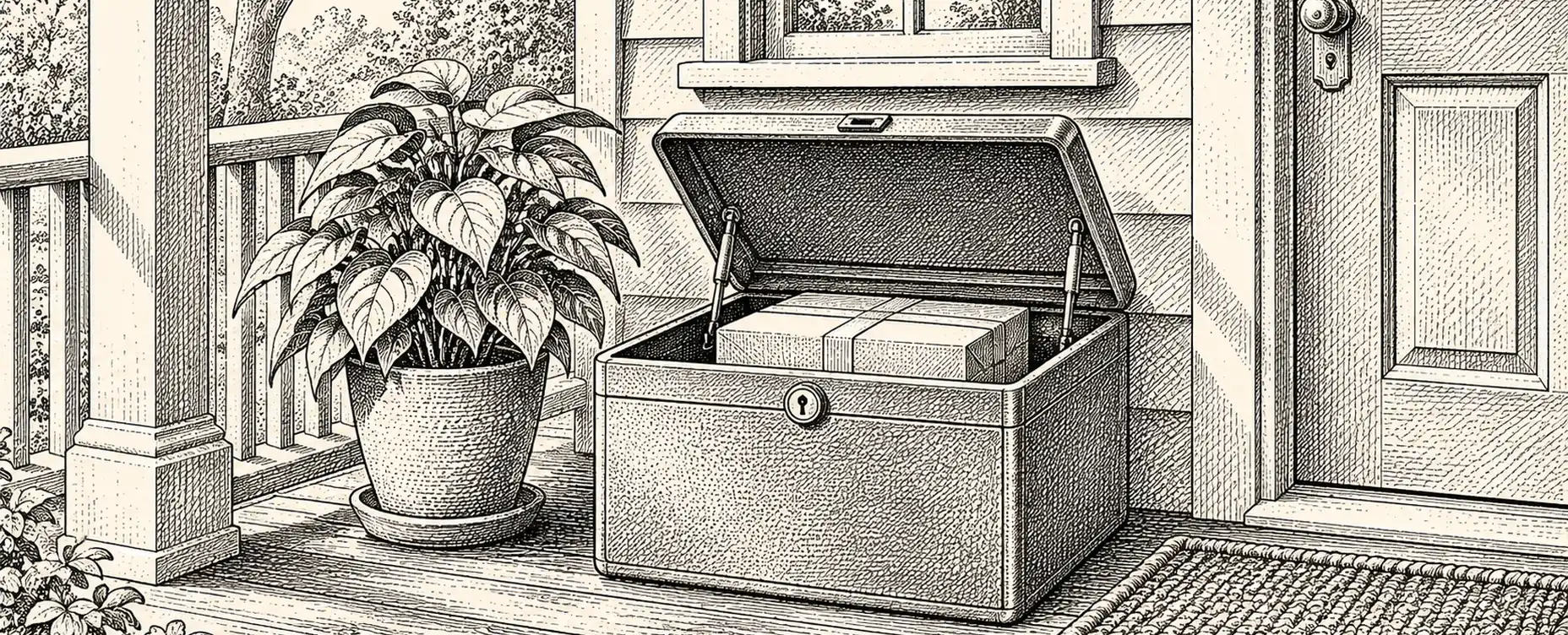
A parcel box or drop box. A secure, weatherproof box that a driver can post into but not retrieve from. Look for a genuine one-way mechanism — several cheap boxes can be reached into — a size that fits realistic parcels, drainage so contents do not sit in water, and a way to bolt it down or secure it to the wall. This single purchase resolves the majority of delivery problems for most households.
A smart parcel box adds a lock the courier opens with a one-time code, plus notification on delivery. More capable, more expensive, and dependent on the courier engaging with the system — which they may not.
A safe place, well chosen and documented. Most couriers let you nominate one. Choose somewhere genuinely out of sight and dry, and describe it precisely in the delivery notes. A vague note produces a parcel on the step.
Lockers and shop collection points. Frequently the best answer for anything valuable, and often free. They remove the last-metre problem entirely.
A neighbour, arranged in advance, which works well and depends on somebody being in.
Where we would be cautious
In-home delivery — giving a courier a one-time code to your front door — exists, and the risk is asymmetric. A parcel is worth tens or hundreds; access to your home is worth considerably more, and you have no relationship with the individual driver. If you do use it, ensure the code is genuinely single-use and time-limited, that you are notified, that the entry is recorded, and that an interior door limits how far the access goes.
In-garage delivery is a middle ground and rather better, since the garage is separable from the house — provided the internal door is properly locked, which as we note elsewhere it often is not.
Leaving a key safe code with couriers. No. That code is your house.
Our honest position: a good parcel box achieves nearly all of the benefit with none of the exposure, and it works with every courier rather than one.
Automations that help
Package detection notification, if your doorbell supports it and its vertical view covers the step. Useful and not entirely reliable, so treat it as a prompt.
Parcel box opened. A contact sensor in the box tells you something arrived, which is more dependable than image recognition and costs a fraction as much. This is our favourite delivery automation.
Light the doorstep on approach after dark, which helps the driver find the bell and improves any footage.
A visible note. Some doorbells can play a message on motion or on press — “parcels in the box to your left” — which is more likely to be followed than a note in an app the driver may never see.
Reminder to bring it in. A parcel box opened but nobody home yet, then a nudge on arrival. Boxes left full get forgotten and boxes that are full cannot take the next delivery.
Do not announce absence. An automatic reply or a sign saying “we are out, leave it anywhere” tells more than the courier.
Flats and shared entrances
Harder, and worth its own section, because most advice assumes a house with a front door.
Video entry systems vary enormously, and in a managed building you usually cannot change them. Some can be extended with a module that forwards calls to a phone, which is worth asking the managing agent about rather than fitting unilaterally.
Communal parcel arrangements — a shared locker bank, or a concierge — are the real solution, and they are a building decision rather than an individual one. Raising it with a residents' association is often more productive than any device.
Collection points are frequently the pragmatic answer in a flat, and there is no shame in that.
Do not fit anything to communal areas without permission. Cameras in shared hallways raise data protection questions and are usually prohibited by leases.
Returns, which nobody plans for
The reverse journey is now almost as frequent as the delivery and gets no attention at all.
A parcel box that works both ways is useful, and most do not — a one-way mechanism that a courier can post into cannot be opened by them to collect from. Smart boxes with a courier code handle this; simple boxes do not, which is worth knowing before you buy one on the assumption it covers returns.
Collection from a doorstep has the same “were you in?” problem as delivery, so the same fixes apply: be heard, and give the driver a precise place to look.
Keep the packaging until you are sure, which is dull advice and saves a great deal of trouble.
Photograph the item and the label before it leaves, and log the tracking number somewhere you will find it. Disputes about returns hinge on evidence, and a photograph with a timestamp is the cheapest insurance available.
What we would do
- Make sure the doorbell is heard inside, with a real chime and not just a phone.
- Make the doorbell obvious and lit at dusk.
- Buy a proper parcel box, one-way, drained, bolted down. This is the main fix.
- Add a contact sensor in the box for reliable delivery notification.
- Document a genuine safe place precisely with each courier.
- Use collection points for anything valuable.
- Light the approach after dark.
- Do not give couriers access to your house.
Item three does more than everything else combined, costs less than a mid-range camera, and needs no subscription, no network and no app.