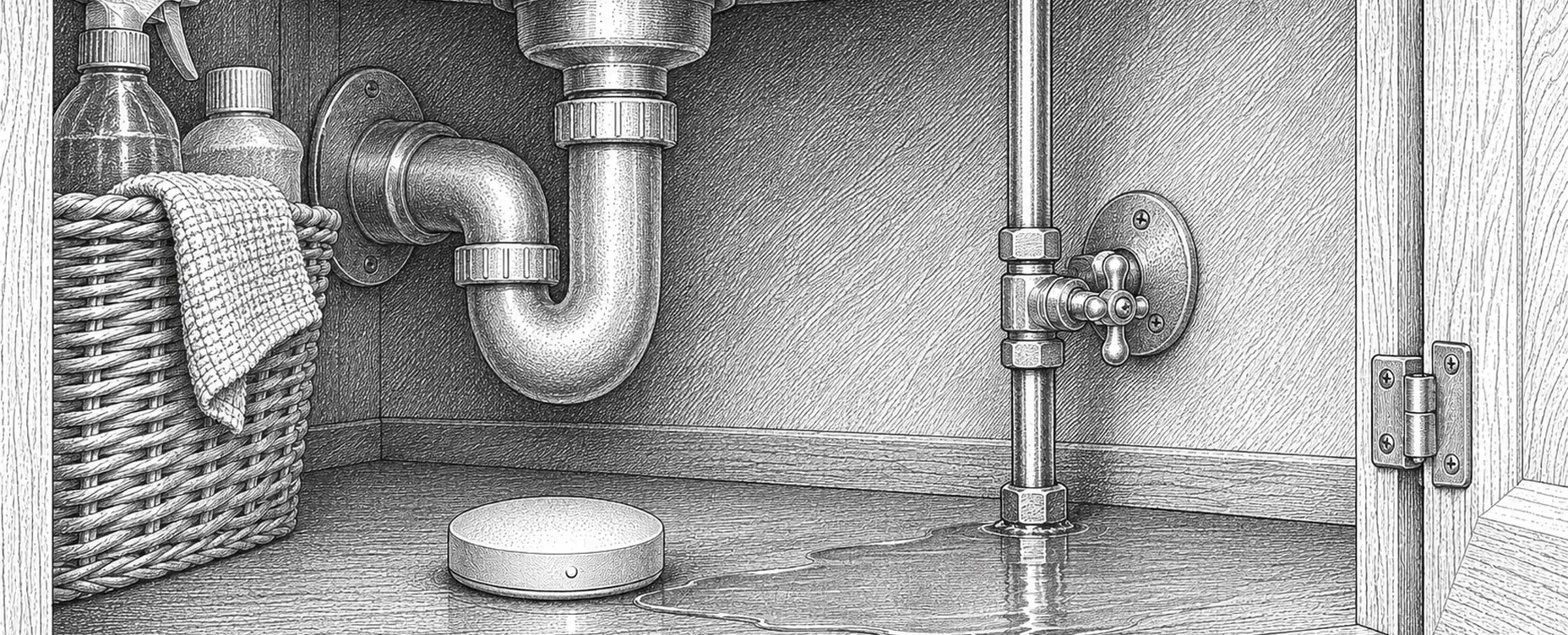
If we could persuade a household to buy one category of sensor, it would be leak detection. Escape of water is consistently among the most frequent and most expensive domestic insurance claims — ahead of fire and ahead of theft in many markets — and unlike those two, it is largely preventable with equipment that costs very little.
The reason is timing. A burst pipe or a failed appliance hose delivers water continuously, and the difference between catching it in two minutes and catching it in two days is the difference between a mop and a new floor, ceiling and kitchen.
How water damage actually happens
Not usually dramatically. The common causes, in rough order:
Appliance hoses. Washing machines and dishwashers have flexible supply hoses under mains pressure permanently. They perish, and when one fails it delivers water at full flow into a room, often behind a machine where nobody looks.
Slow joint and fitting leaks. A weeping compression joint under a sink or behind a bath drips for months, rotting the floor and feeding mould, and is discovered when something gives way.
Failed seals. Shower trays, bath seals and tiling that has quietly lost its grout, sending water into the structure with every shower.
Toilet and cistern failures, which can run continuously and unnoticed, especially in a second bathroom.
Heating system leaks, from radiator valves, towel rails and pipework under floors.
Frozen pipes bursting, which is the one that causes the most damage per event, because it delivers a lot of water into a cold empty property.
Water heaters and cylinders failing at the end of their life, which they do without warning.
Notice how many of them are hidden. That is precisely why sensing works: the water is not the problem, the delay in noticing is.
The three tiers of protection
Tier 1: spot sensors
Small battery sensors placed where water would appear. They cost very little each, last years, and alarm within seconds of getting wet.
Where to put them, in priority order: behind and under the washing machine and dishwasher; under every sink; beside the boiler, cylinder or water heater; under the bath and at the shower tray edge; at the lowest point of any basement or cellar; beside the mains stopcock and any manifold; and next to a fridge with a plumbed water line, which is a frequent and surprising culprit.
Two practical notes. Place them on the floor at the lowest point, because water goes where gravity takes it rather than where the pipe is. And prefer sensors with a remote probe on a lead or a rope-style sensing cable for awkward gaps, since a puck you cannot reach behind an integrated appliance is a puck you will never test.
Tier 2: whole-house monitoring
A device on the incoming main that measures flow, and sometimes pressure and temperature. It detects patterns rather than puddles, which means it catches leaks nowhere near a sensor — under a floor, in a wall, in the garden supply.
The rules that make it work: continuous flow for longer than any legitimate use — say thirty minutes — suggests something is running; any flow at all when the house is in away mode is suspicious; and a very high flow rate suggests a burst rather than a tap.
Tier 3: automatic shut-off
A motorised valve on the incoming main that closes on command. This is what turns detection into prevention, because it acts in the middle of the night when nobody is reading notifications.
Two forms exist. An integrated monitor and valve in one unit, which is tidy and self-contained. Or a separate valve actuator fitted to your existing stopcock, controlled by your hub, which is cheaper and more flexible and lets any sensor in the house trigger it.
The combination worth building: any spot sensor going wet, or the flow monitor detecting an anomaly, closes the valve and notifies. That is the arrangement that actually prevents the claim.
The practical objections, answered
“What if it shuts off wrongly?” A false shut-off is inconvenient for an hour. A real leak not shut off is a five-figure repair. The asymmetry is enormous, and it should settle the argument. Do make sure you can reopen the valve manually and easily.
“What about the heating system?” A sealed heating system is not fed continuously, so closing the mains does not affect it immediately. Do check whether anything in your house needs a continuous supply.
“What if the power fails?” Ask what the valve does on power loss and choose deliberately. Most stay in their last position, which is usually right. A small uninterruptible supply on the hub and valve is cheap insurance.
“Will it stop a burst?” It will stop the supply feeding it. Water already in the system will still drain out, so damage is limited rather than eliminated — which is still the difference between a wet floor and a ruined ceiling.
Where sensors need to be smarter than a threshold
Some situations produce false alarms and are worth designing around.
A shower tray sensor will get splashed. Place it just outside the tray where a leak would run, not where a foot drips.
Condensation under a cold pipe or a fridge can wet a sensor slowly. A sensor requiring wetness for thirty seconds before alarming avoids the transient.
Mopping and cleaning. Give the household a way to mute for an hour.
Humidity-only sensors in a bathroom are not leak sensors, and treating them as such produces alarms every shower.
Freezing, which the same equipment catches
A frozen pipe that bursts is the most damaging single event, and it announces itself in advance if you are watching.
Put a temperature sensor anywhere pipework runs through cold space — loft, garage, exterior wall, under a suspended floor, an unheated utility room — and alert below 4 °C. That gives you time to act before the freeze, which is the only useful moment.
Better still, tie it to action: a low temperature in the loft could raise the heating setpoint slightly, and a low temperature plus an empty house could close the mains and notify. Prevention beats detection here, because a burst pipe cannot be undone.
Insurance, worth a paragraph
Some insurers now offer discounts for monitored leak detection with automatic shut-off, and some policies have conditions about unoccupied properties — minimum heating temperatures, maximum periods, requirements to drain systems in winter.
Two practical steps: ask your insurer whether they recognise leak protection, because the discount can offset a chunk of the hardware cost, and read the unoccupancy clause before you next travel. We are not insurance advisers, and policy wording varies enough that a five-minute read is worth more than any general advice.
A staged plan
- Find your stopcock. Now, not during an emergency. Check it actually turns — many are seized. Show everyone in the house.
- Buy five spot sensors: washing machine, dishwasher, kitchen sink, bathroom, boiler or cylinder.
- Add temperature sensors wherever pipes run through cold space.
- Replace old flexible appliance hoses, which are consumables, and fit isolation valves so they can be turned off easily.
- Add whole-house flow monitoring to catch what sensors cannot see.
- Fit an automatic shut-off valve and wire every sensor to it.
- Test the whole chain with a damp cloth on a sensor, and confirm the valve closes and you are notified.
- Turn the water off when you go away. Free, and the most effective item on this list.
Step one costs nothing and is the one most households cannot do today. Step eight is free and prevents more damage than anything else here.