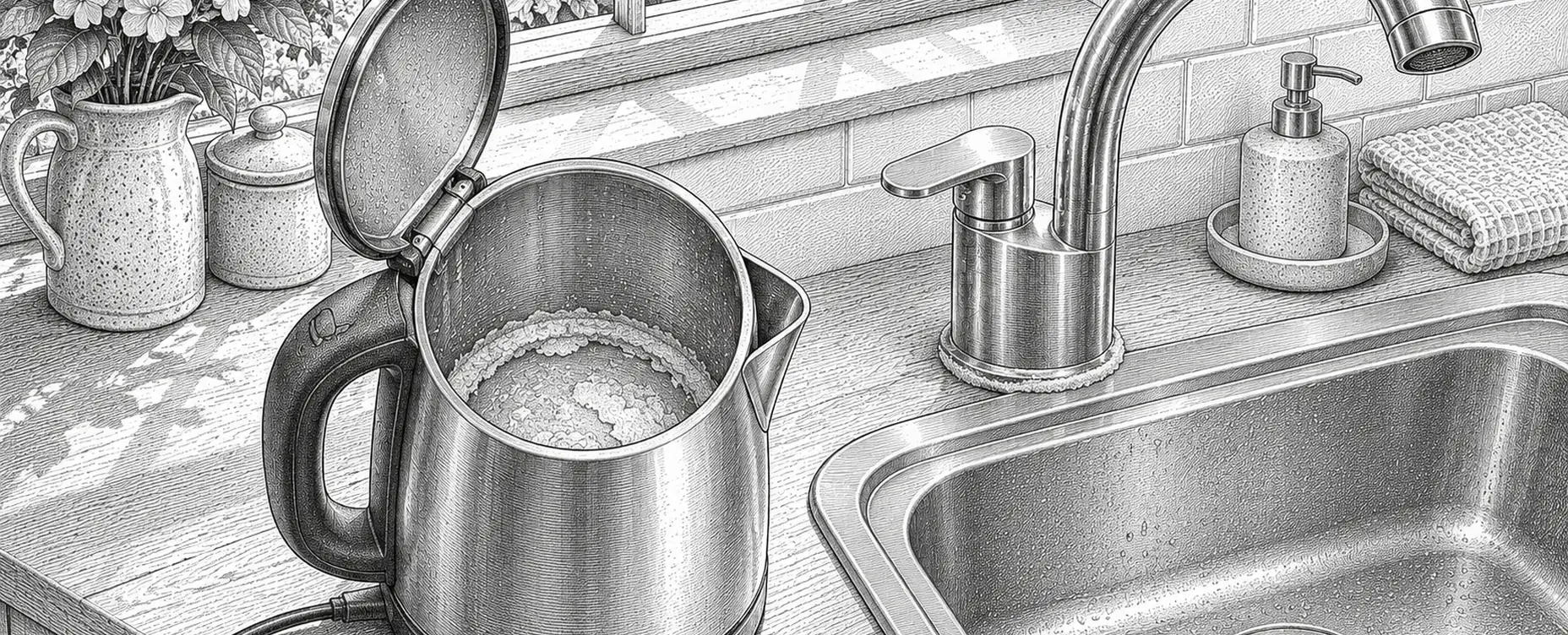
Hard water is one of those household facts that people accept as normal until they see what it is doing. It scales kettles, blocks shower heads, coats heating elements, shortens appliance life and makes soap work less well.
Whether to do anything about it depends on how hard your water actually is, and on being clear about which products do something and which do very little.
What hardness is
Hard water contains dissolved calcium and magnesium, picked up as rain passes through chalk and limestone. It is not a contaminant and it is not unhealthy — some evidence suggests dietary benefit from the minerals — but it changes how water behaves.
The problem is that these minerals come out of solution when water is heated or left to evaporate, depositing as limescale: the hard white or grey crust in a kettle, on a shower screen, and invisibly on every heating surface in your house.
Hardness is measured in several units, which makes comparison annoying. Commonly you will see milligrams per litre of calcium carbonate (or the equivalent parts per million), degrees of German hardness written °dH, or degrees Clark in the UK. Broad bands in mg/l: under 50 is soft, 50 to 100 moderately soft, 100 to 200 hard, above 200 very hard.
Your water supplier publishes the figure for your postcode, usually on their website, and that is the number to start from. Cheap test strips give a reasonable cross-check.
What scale actually costs you
Heating efficiency. Scale is an insulator. A scaled immersion element or heat exchanger has to run hotter and longer to deliver the same heat, and studies of scaled heating surfaces consistently show measurable efficiency losses even at modest thicknesses.
Appliance life. Washing machines, dishwashers, boilers, coffee machines and showers all fail earlier in hard water areas. Combi boiler heat exchangers are particularly vulnerable, since they heat water rapidly to a high temperature.
Blockages. Shower heads, spray taps and small-bore pipework gradually restrict.
Cleaning effort. Soap reacts with hardness minerals to form scum rather than lather, so you use more detergent and spend more time on glass and tiles.
Skin and hair, where many people report a real difference after softening, and where the evidence is more about comfort than health. There is some research linking hard water to eczema symptoms in children, which is suggestive rather than settled.
Scale forms faster at higher temperatures, which creates the tension we describe elsewhere: hot water needs to be stored at 60 °C for legionella control, and that is also where scale accelerates. Store at 60 rather than above it, and descale periodically.
Water softeners: what they do and what to know
A true water softener uses ion exchange: water passes through resin beads that swap calcium and magnesium ions for sodium ions. The water leaving is genuinely soft, and no scale forms downstream.
This works, unambiguously, and it is the only domestic technology that actually removes hardness. Points worth knowing before buying:
It adds sodium. The amount depends on incoming hardness, and it is usually modest — but softened water is normally not plumbed to the drinking water tap, both for taste and because sodium intake matters for people on restricted diets. A standard installation leaves the kitchen cold tap on hard mains water. Do not bypass that arrangement, particularly for making up infant formula.
It needs salt and it uses water. The resin regenerates periodically, consuming salt and flushing to drain. Running costs are ongoing rather than trivial.
It needs space and a drain, usually near the incoming main.
Metered regeneration beats timed. A metered unit regenerates according to how much water you have used rather than on a schedule, which uses noticeably less salt and water.
Check local rules on discharging the regeneration brine, which is restricted in some areas.
Our view: in a very hard water area with a combi boiler or a lot of appliances, a metered softener is a reasonable investment. In a moderately soft area it is hard to justify.
Alternatives, assessed honestly
Scale inhibitors — polyphosphate dosing cartridges, commonly fitted before a combi boiler — do not remove hardness. They alter how crystals form so scale is less inclined to adhere. The evidence for boiler protection is reasonable, they are cheap, and they need periodic replacement. They do not stop scum in your shower or scale on your taps.
Electronic and magnetic conditioners claim to alter crystal behaviour by applying a field. This is the category where marketing outruns evidence considerably. Some laboratory studies show effects under specific conditions; independent real-world testing has been inconsistent, and there is no removal of hardness at all. We would not spend money here, and we would be sceptical of any product making dramatic claims without independent testing.
Template-assisted crystallisation media are a newer physical approach that converts hardness into microscopic crystals that stay suspended rather than adhering. There is more supporting evidence than for magnetic devices, it uses no salt and no drain, and it does not soften the water — scum and spotting remain.
Point-of-use filters in a kettle or a jug improve taste and reduce kettle scale and do nothing for the rest of the house.
The honest summary: only ion exchange removes hardness. Inhibitors and crystallisation media are legitimate scale-reduction measures for equipment protection. Magnetic conditioners are not something we would recommend.
Living with hard water without a softener
Plenty of households take this route, sensibly.
Descale routinely rather than reactively — kettle, shower head, coffee machine, on a schedule. Citric acid or white vinegar handles most of it cheaply.
Keep stored water at 60 °C rather than higher, which slows deposition while maintaining legionella control.
Use the right detergent dose for your hardness. Most packaging gives guidance, and under-dosing in hard water is why washing sometimes comes out grey.
Fit dishwasher salt properly, since dishwashers contain a small built-in softener that needs it, and set the hardness level on the machine to match your supply. Many people never do this, and it is the commonest cause of cloudy glassware.
Squeegee the shower screen. Unglamorous, and it prevents the deposits that later need acid.
Fit an inhibitor before the boiler, which is cheap protection for the most expensive item.
What to monitor
Hardness itself does not change quickly, so monitoring is about consequences.
Cylinder or boiler reheat duration. A trend towards longer reheats for the same temperature rise is a scale signature, and it is measurable if you log it.
Energy per unit of hot water. Same idea, expressed in kilowatt-hours.
Flow rate at showers and taps. A gradual decline suggests restriction.
Softener salt level, which some units report and which is otherwise an easily forgotten chore. A simple reminder based on regeneration count avoids the fortnight of hard water nobody notices until the kettle scales.
Water use during regeneration, which should be a predictable volume; a softener stuck in regeneration can waste a great deal, and this is the kind of anomaly whole-house flow monitoring catches.
What we would do
- Look up your hardness on your supplier's website before spending anything.
- Under 100 mg/l: descale occasionally and do nothing else.
- 100–200 mg/l: fit an inhibitor before the boiler, set your dishwasher hardness correctly, descale on a schedule.
- Above 200 mg/l: consider a metered ion exchange softener, leaving the kitchen cold tap on hard water.
- Whatever you do, keep stored hot water at 60 °C for legionella control and accept the descaling that comes with it.
- Log reheat duration so scale shows up as a trend rather than a failure.
- Skip the magnetic conditioners.
Step one is the one that saves money. A good number of people buy softeners in areas where the water was never hard enough to justify one.