Leaving the house empty: a holiday checklist beyond lights on a timer
Theft is only one of the things that goes wrong in an empty house, and it is not the most common or the most expensive. Here is the full pass, in order.
Theft is only one of the things that goes wrong in an empty house, and it is not the most common or the most expensive. Here is the full pass, in order.
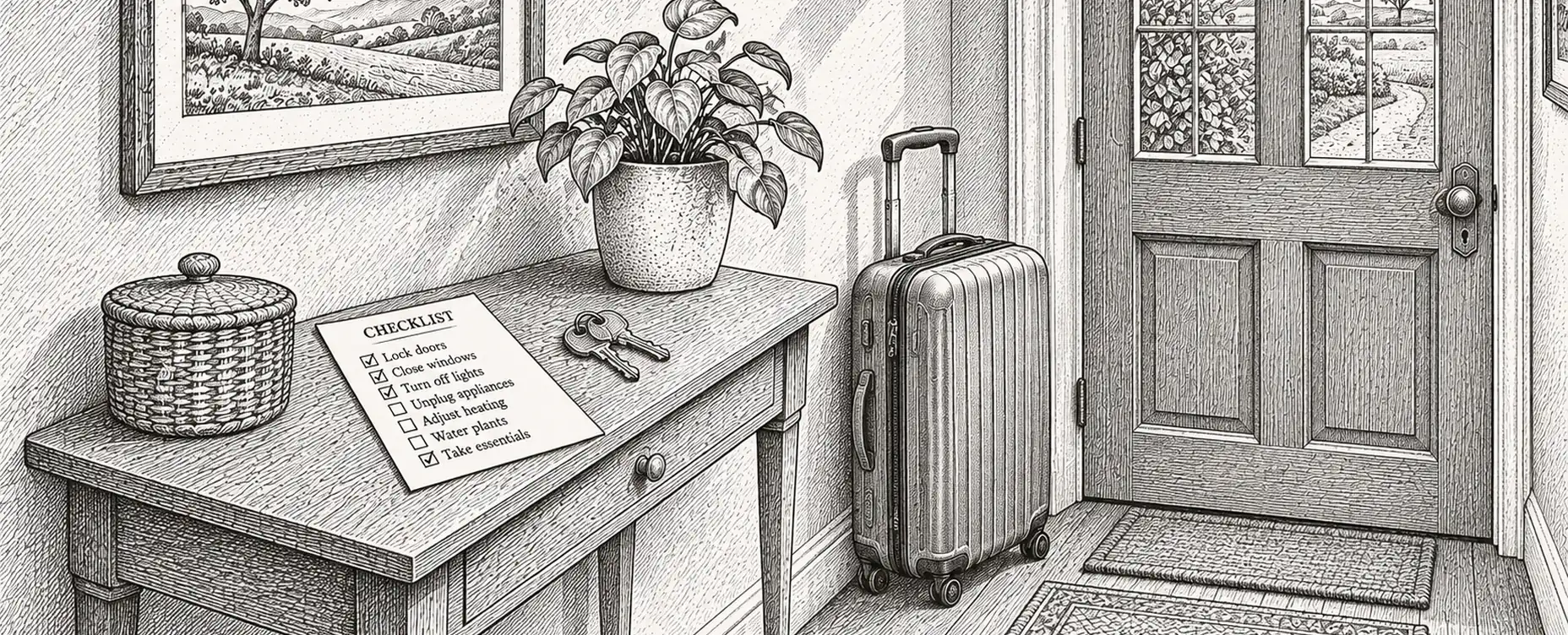
Leaving a house empty for two weeks is the situation a smart home is best suited to, and also the one where the gap between a well-prepared house and a lightly-prepared one is widest. Most holiday advice stops at “put a lamp on a timer”, which as we have written elsewhere can actively signal absence.
Here is a fuller checklist, in the order we would work through it, covering the things that actually go wrong. Note that theft is only one of them — water damage, freezing and a failed freezer are all more common and cost more on average.
Sort out post and deliveries. An overflowing letterbox and parcels on a doorstep are the clearest possible signal that nobody is home. Suspend deliveries, or arrange for someone to clear them.
Cancel anything that arrives on a schedule — a veg box, a milk delivery, a gardener whose van in the drive is fine but whose absence for three weeks is visible in the lawn.
Tell one neighbour, and only the people who need to know. A neighbour who has your number and knows to expect nothing is worth more than any device. Do not announce it publicly, and do not post photographs while away.
Check your insurance conditions. Many policies have an unoccupancy clause — often around 30 days — and some require heating left on above a minimum temperature or water drained during winter absences. Non-compliance can invalidate a claim, which is an expensive way to find out.
Test your notifications. Deliberately trigger each alert you intend to rely on and confirm it arrives on your phone. An untested alert path is not a safety net.
Water is the big one. Escape of water is one of the most frequent and most expensive domestic insurance claims, and a slow leak in an empty house has weeks to work. If you have a whole-house shut-off valve, turning it off is the single most effective thing on this page — unless you have a heating system, irrigation or an ice maker that needs supply. If you cannot shut off everything, shut off what you can: the washing machine, dishwasher and outside taps.
Set heating to a frost-protection minimum rather than off, in any climate where freezing is possible. A burst pipe costs vastly more than two weeks of low background heating, and your insurer may require it.
Unplug what does not need to be plugged in. Not for energy — for fire risk and surge protection. Chargers, extension leads, anything with a heating element.
Empty the bins and check the fridge for anything that will make its presence known.
Close and lock everything, including first-floor windows and the door from an integral garage, which is a commonly forgotten weak point.
Leave curtains and blinds in a normal daytime position, or better, on automation. Everything closed for a fortnight is a signal.
The aim is a house that behaves like an occupied one, not a house that performs occupancy.
Lighting relative to sunset, not the clock. Sunset shifts by well over an hour across a fortnight in spring and autumn, and fixed times drift visibly out of step.
Movement between rooms. Kitchen and hall early evening, living room later, a landing and a bedroom last, all off within a plausible window. Add fifteen or twenty minutes of randomisation so no two evenings match.
Blinds and curtains operating. A stronger occupancy signal than lighting, because it is harder to fake with a plug-in timer and therefore reads as real.
Occasional sound. A radio in a back room for an hour in the evening. Effective, and inaudible from the street unless you overdo it.
Nothing at 3am. A light coming on at an implausible hour draws precisely the attention you were avoiding.
And keep it plausible in scale. Two or three rooms behaving sensibly is convincing; the whole house cycling through a sequence is not.
This is where the money is, and none of it is about burglary.
Leak sensors under the sink, behind the washing machine, by the boiler or cylinder, and beside any radiator you have ever seen weep. A few pounds each, and they catch the failure mode that causes the most damage. Better still, pair them with an automatic shut-off valve so the water stops without you.
A temperature sensor in the coldest part of the house, alerting below about 5 °C. This is your freeze warning and it gives a neighbour time to act.
A freezer temperature alert. A failed freezer or a door left ajar is discovered on your return otherwise, and the smell is memorable.
Humidity monitoring in bathrooms and any room prone to damp, since a closed-up house in summer can develop mould in a fortnight.
Power monitoring or a simple mains-loss alert, because a power cut while away silently ends your heating, your freezer and much of your automation. Knowing is what lets you ask someone to check.
Smoke and CO notification, which is the one that matters most and the one that requires your alarms to be able to reach you.
Somebody local should be able to get in, and how you arrange that matters.
Give a trusted neighbour or family member their own code on a smart lock rather than a shared one, so you can see when it was used and revoke it afterwards. Avoid leaving a physical key anywhere outside the house; the places people hide keys are the places people look for them.
Then tell them, in writing, the three things they might need to do: where the water shut-off is, where the consumer unit is, and your number. Most emergency calls to a house-sitter fail on the first of those.
The return is worth a few minutes of thought too, because problems that started while you were away are easiest to catch on the first day back.
Turn the water back on slowly and then listen. A stop tap opened fully in one movement can dislodge debris, and a house that has been dry for a fortnight sometimes reveals a weeping joint within the hour. Check under sinks and around the boiler before you unpack.
Read your energy history. A flat line where the freezer should be cycling, or heating that ran far more than expected, tells you something happened. This is the clearest use of monitoring you will get all year.
Run taps and showers for a minute. Water standing in pipes at warm temperatures for weeks is worth flushing through, particularly in a shower head that has sat unused.
Turn away mode off deliberately. Every household has a story about motion-triggered lights and notifications continuing for days because nobody switched the holiday routine off. Build the disarm into your arrival automation rather than relying on memory.
If you do nothing else:
Items one and two prevent the expensive damage, three and four prevent the burglary, and five and six are the ones people do first.