Cameras and privacy: where they belong, and where they really do not
Name the question the camera answers and placement mostly follows. Then there are the placements that are never a judgement call.
Name the question the camera answers and placement mostly follows. Then there are the placements that are never a judgement call.
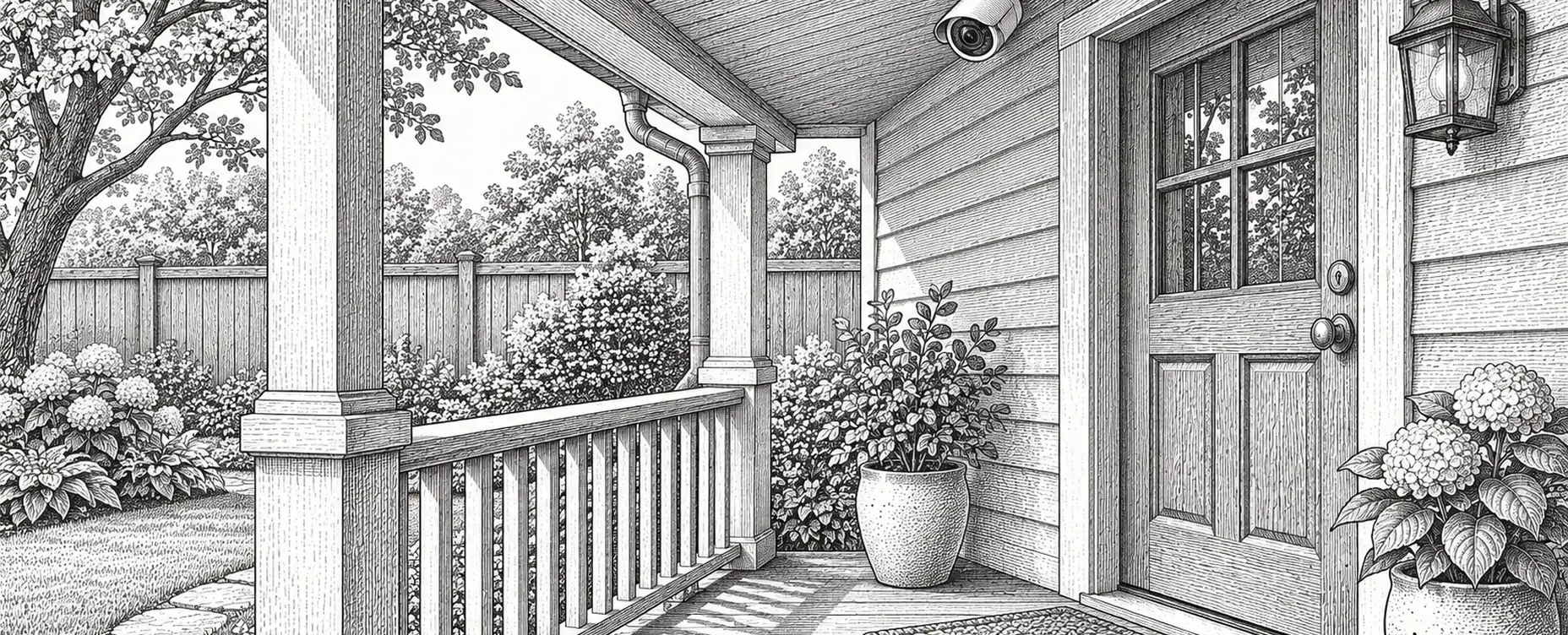
Cameras are the most useful and the most socially complicated device in a smart home. A camera at the front door is uncontroversial. A camera in a hallway is a conversation. A camera in a room where a guest sleeps is a serious problem, and in many places a criminal one.
Getting this right is partly legal, partly technical and mostly about being a considerate neighbour and host. Here is a framework that keeps you on the right side of all three.
Almost every placement mistake comes from installing a camera without a specific question in mind. Name the question first and placement usually answers itself.
“Who came to the door?” A doorbell camera, framed on the approach and the doorstep, tilted so it captures faces rather than the top of heads.
“Did a parcel arrive and is it still there?” Same device, or one covering the porch.
“Is anyone in the garden at night?” An outdoor camera with genuinely good low light performance, pointed at your own boundary.
“Is the dog on the sofa?” An indoor camera with an obvious physical shutter, and a household conversation about it.
“What happened while we were away?” Indoor cameras that are active only in away mode, which is a very different proposition from cameras running constantly.
If you cannot state the question, you probably do not need the camera in that room, and installing one anyway is how households end up with surveillance they resent.
These vary by country, so treat this as the shape of the law rather than the letter of it — but the shape is fairly consistent across Europe and much of the world.
Filming your own property is generally fine. Your garden, your driveway, your doorstep.
Filming beyond your boundary attracts obligations. Once a camera captures a public pavement, a shared path or a neighbour's garden, you may move from a purely domestic activity into data protection territory — in the EU and UK, the household exemption in data protection law can stop applying, which brings duties around signage, retention and responding to requests. Practically: angle the camera down and inward, use privacy masking to black out areas outside your boundary, and do not point a camera at a neighbour's window.
Audio is treated more strictly than video in many jurisdictions, because recorded conversation is considered more intrusive than an image. If your doorbell records audio from the pavement, consider turning audio recording off; the deterrence and evidence value is mostly visual anyway.
Signage helps. A small, visible notice that recording takes place is good practice, is required in some places once you record beyond your boundary, and adds deterrent value at no cost.
Some placements are not a judgement call.
No cameras in bathrooms or bedrooms of a shared or let property. Not concealed, not disclosed, not disabled-but-present. In many jurisdictions this is a criminal offence, and every short-let platform bans it outright.
No concealed cameras where guests, lodgers, cleaners or contractors have a reasonable expectation of privacy. The concealment is the problem, legally and morally. A disclosed, visible camera in a hallway achieves the same security outcome and is defensible; the same camera hidden in a smoke detector housing is not, and being caught with one destroys trust irreparably even where it is lawful.
No cameras monitoring employees or domestic staff covertly. Employment law adds another layer of obligation here and it is stricter than most people assume.
If you want to know whether a short-let property is being used for a party, use occupancy, noise-level or air quality sensors that report a decibel figure or a headcount rather than an image. They answer the question you actually have without recording anyone, and they are what responsible hosts use.
Where the video is stored. The single most consequential choice. Local storage — a card in the camera, or a network recorder — keeps footage on your premises and working during an internet outage. Cloud storage is convenient, survives the camera being stolen, and means your footage sits on someone else's infrastructure under someone else's terms. Many people sensibly want both: local as primary, cloud for a short retention window of important events.
Whether it works without the internet. Ask specifically. A camera that will not record or notify locally when your connection drops has an obvious weakness, since cutting a connection is trivial.
Subscription structure. Check what stops working when you stop paying. On some products that is cloud history only; on others it is person detection, notifications or recording altogether. This belongs in the purchase decision, because a cheap camera with a mandatory subscription is not cheap.
Low light performance over resolution. Most events you care about happen in poor light. Infrared gives you usable monochrome; a camera with a good sensor and a spotlight gives you colour, which is far more identifying. Both beat a high-resolution sensor in the dark.
Retention period. Keep footage for as long as it is useful and no longer — a week or two covers almost every real need. Indefinite retention creates risk without adding value.
Cameras inside a home affect everyone who lives there, and installing them unilaterally causes entirely avoidable friction.
Three practices resolve most of it. Physical shutters on indoor cameras, so “off” is visible rather than a setting somebody has to trust. Away-mode activation, so indoor cameras are simply inactive whenever anyone is home — which is what most people actually want and which removes the objection entirely. And agreement on who can view footage, before rather than after.
The same courtesy extends outward. Tell your immediate neighbours what your camera can see, and show them if they ask. A two-minute conversation prevents a dispute that can run for years, and in our experience the neighbour who was shown the view is the one who later tells you about the van that parked oddly.
Two cameras placed thoughtfully outperform six placed defensively, and cost a great deal less to run.