Shared energy and water: metering, billing and resident trust
Monitoring shared consumption is straightforward. Billing individuals from it is regulated. Confusing the two is how metering projects generate opposition.
Monitoring shared consumption is straightforward. Billing individuals from it is regulated. Confusing the two is how metering projects generate opposition.
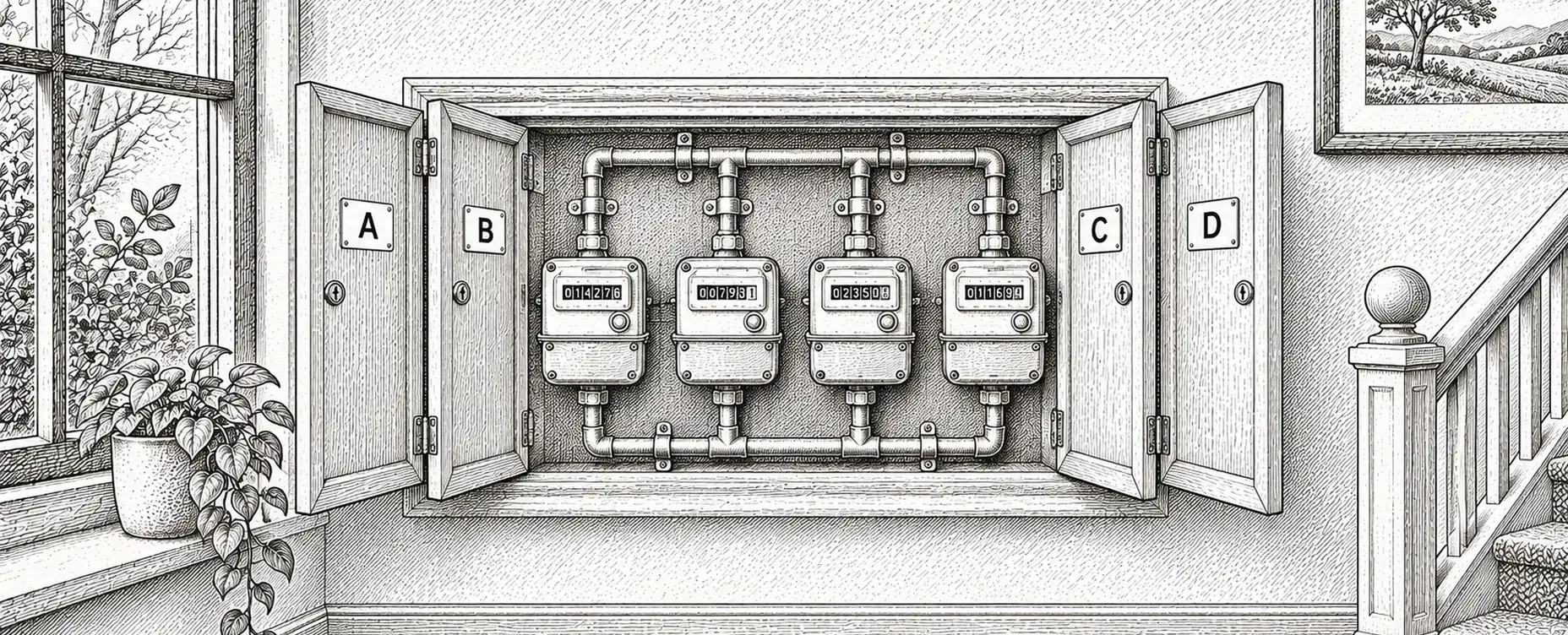
Shared energy and water are among the most persistent sources of friction between residents and managing agents. The costs appear in a service charge as a single line, nobody can see what drives them, and any increase is met with the reasonable question of what exactly is being paid for. Metering answers that question, and it also opens one that has to be handled carefully: who pays for what.
It is worth separating them at the outset, because they have different purposes and different legal weight.
Monitoring means measuring consumption to understand and reduce it. The data informs management decisions and is reported to residents in aggregate. Legally straightforward.
Billing means charging individuals based on measured consumption. This is regulated, requires equipment of a specified accuracy and approval, and involves consumer protection rules about how charges are calculated and disputed. Considerably more demanding.
Most managing agents should begin with monitoring, and treat billing as a separate project with professional advice.
The starting point, entirely within your control, and usually revealing.
Communal electricity covers lighting, lifts, pumps, ventilation, door entry and often plant. Sub-metering it — and ideally splitting it further by lighting, lifts and plant — converts a service charge line into something you can act on.
Two findings are near-universal. The overnight baseline is higher than expected, and investigating it turns up plant running unnecessarily, a heater somewhere nobody remembers, or a circuit that cannot be accounted for. And one or two items dominate, which focuses effort far better than general exhortation.
Communal water is frequently unmetered or metered only at the boundary. A meter with continuous logging is the only practical way to find the leaks discussed in the stacked-building leak article, and in a large block a persistent underground or riser leak can run for years.
Communal heating, where a shared boiler or district connection serves the building, is usually the largest single cost. Metering the primary circuit and the heat delivered is the basis of both efficiency and any future billing.
Where a building has communal heating, several jurisdictions now require or encourage individual heat metering so that residents pay for what they use rather than by floor area. This is a substantial subject with real regulatory content.
The honest summary: heat metering for billing requires approved meters, a defined calculation methodology, and compliance with national rules on cost allocation and dispute handling. It is not a smart home project. Where the requirement applies, it is generally implemented with purpose-built heat meters or heat cost allocators, and the calculation typically apportions a share of total cost by measured consumption with the remainder by a fixed method, precisely because a flat in the middle of a block benefits from its neighbours' heat.
Per-apartment consumption data is valuable and it is also personal data about identifiable households, which changes the obligations considerably.
Energy consumption reveals a great deal: when people are home, when they wake, whether a flat is occupied at all, and sometimes whether someone is unwell or absent. That makes it sensitive in ways a corridor light level is not.
If you collect it, the principles are the same as elsewhere in this field but the stakes are higher. State the purpose narrowly and do not repurpose it — using consumption data to infer subletting or occupancy would be a serious breach of trust and probably of law. Aggregate for reporting: building-level and floor-level figures are useful management information, and individual profiles are not something anyone in your office needs to browse. Set a retention period. Restrict access to named individuals. And tell residents plainly what is measured and why.
Residents generally welcome their own consumption data, which is the version worth providing: give each household access to their own figures and the building's aggregate, and keep individual data away from everyone else.
Metering proposals attract suspicion, usually because they are perceived as a precursor to higher charges. Three things help substantially.
Lead with the communal supplies, not the flats. Nobody objects to measuring the corridor lights, and demonstrating a reduction there builds the credibility to discuss anything else.
Report results, not intentions. A line in the annual statement showing that communal electricity fell by a measured amount after a specific investment does more than any consultation document.
Be explicit about what you are not doing. If there is no plan to bill individually, say so. If there is, say that too, with the timeline and the methodology. Ambiguity is what generates opposition.
It is also worth knowing whether communal alterations or a change in charging basis requires a formal resident decision under your ownership structure. Establish that before announcing anything.
Worth its own mention because it is the fastest-growing pressure on residential building electrical capacity, and the buildings that handle it badly do so by not deciding anything until several residents have installed chargers independently.
The technical constraint is the building’s incoming supply capacity, which in most older blocks was designed long before anyone charged a car. Ten chargers each drawing 7 kW is more load than many buildings can support simultaneously, and the answer is not a supply upgrade but load management: a controller that shares available capacity between active chargers and throttles them so the building main is never exceeded.
Metering matters here as much as capacity, because charging is billable consumption attributable to an individual. That means MID-approved metering per charge point, and a decision about whether the building bills residents directly or a third-party operator does. Deciding this before installation is considerably easier than retrofitting fairness onto an ad hoc arrangement.
Measurement alone changes nothing. The interventions that follow are the ones described elsewhere in this category, now with evidence behind them.
That last point deserves emphasis: knowing your communal consumption profile lets you procure electricity properly rather than accepting a rollover, and for a large building the difference can exceed everything else in this list combined.
The sequence matters because step five earns the trust that step seven requires. A managing agent who has demonstrably reduced a shared cost has a very different conversation about metering than one who has only proposed it.