Lighting communal areas without lighting them all night
Switching communal lights off is the obvious approach and the wrong one. Dimming to a background level and brightening on approach saves nearly as much and generates no complaints.
Switching communal lights off is the obvious approach and the wrong one. Dimming to a background level and brightening on approach saves nearly as much and generates no complaints.
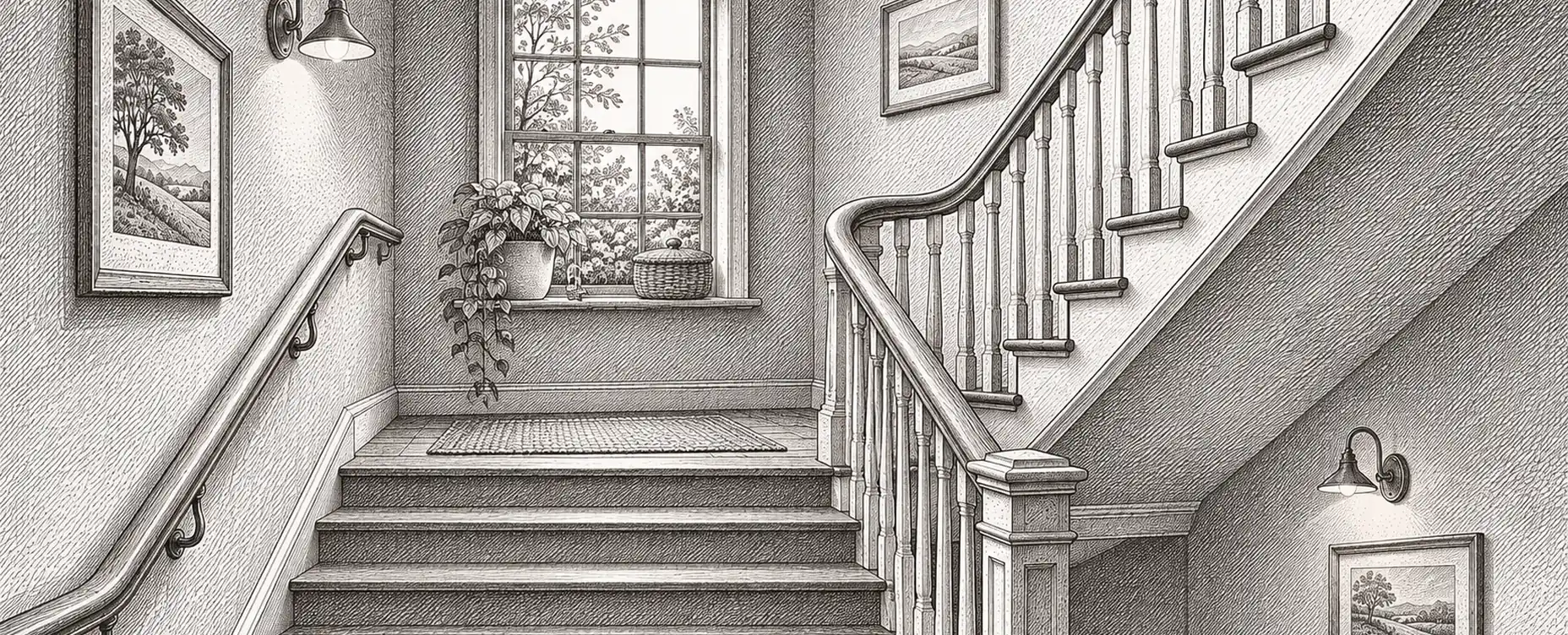
Communal lighting is the classic managed-building expense: it runs continuously, nobody living in the building pays for it directly, and any attempt to reduce it produces complaints about safety. It is also, done properly, one of the largest and easiest savings available — provided you understand why the obvious approach fails.
The instinct is occupancy control: lights off when nobody is there. In a private house that is fine. In a communal area of a residential building it creates three real problems.
Safety and perceived safety. A stairwell that is dark until you are inside it feels unsafe, particularly to residents who are elderly, alone or arriving late. Perception matters here as much as measurable risk, and it will generate complaints regardless of what the lux readings say.
Detection lag. Even a fast sensor leaves a moment of darkness, and on a stair that moment is where the hazard is.
Regulatory constraints. Escape routes have lighting requirements, and emergency lighting is a separate certified system that must never be part of an energy scheme.
The correct pattern is dimming, not switching: communal areas sit at a low background level continuously and rise to full when someone is present. Nobody is ever in the dark, the saving is still large because LEDs at thirty per cent draw a fraction of full output, and the complaints do not arrive.
Dimmed background, full on presence, with generous fade times. Use presence detection rather than simple motion where residents might stand still — at a lift, at a postbox, holding a conversation. Long fade-out looks and feels considerably better than an abrupt drop.
The place to be most conservative. Detect at both ends and on intermediate landings, use long timeouts, and never allow full darkness. Stairs are where falls happen and where a dim moment has real consequences.
Good candidates for more aggressive control, because they are genuinely intermittently used and people arrive with vehicles that are themselves lit. Dimmed background with zoned brightening, so a resident walking to a far corner brings light with them rather than illuminating the whole level. Security is a legitimate consideration, and a well-lit-on-approach car park is usually perceived as safer than a uniformly dim one.
Switch on calculated dusk rather than a fixed clock time, so the schedule stays correct through the year without anyone adjusting it twice a season. Path and step lighting matters for safety; ornamental and facade lighting does not, and can go off entirely at a reasonable hour.
Two considerations specific to outdoors. Neighbours and light spill — aim downward, and be prepared for a complaint if a new floodlight reaches a bedroom window. And wildlife, since continuous bright outdoor lighting affects insects and bats, and in some jurisdictions bat roosts carry legal protection that constrains what you may light.
Straightforward occupancy control with a modest timeout. These are the classic sites of a light burning for months, and nobody objects to a sensor.
Lift car lighting is part of the lift installation and belongs to the lift contractor, not to you. Leave it alone.
Before automating anything it is worth checking what the levels actually are, because a surprising number of communal areas are simultaneously over-lit in the middle and under-lit at the edges.
National standards exist for communal areas and escape routes in residential buildings, typically specifying a minimum illuminance on the floor along the escape route and a higher figure at stairs and changes of level. Measure at floor level rather than at head height, and measure at the darkest point rather than under a fitting — that is what the standard means and it is where the hazard is.
Two common findings. Uneven distribution, where fittings are spaced for a corridor layout that has since been altered, leaves dark patches that no amount of control will fix. And glare on stairs, where a bright fitting is directly in the eyeline of someone descending, which is genuinely hazardous and frequently the real cause of complaints attributed to darkness.
Fixing those is a lighting design job rather than an automation one, and doing it first means the control scheme is regulating adequate light rather than making inadequate light cheaper.
Most managed buildings have old fittings on simple circuits, which constrains the options.
LED replacement first. If fittings are fluorescent or halogen, replacement pays back on energy alone with no control at all, and it is the prerequisite for dimming since not all old fittings dim well.
Integrated sensor fittings are often the cheapest control route in a retrofit. A luminaire with a built-in microwave or PIR sensor and a dimmed standby level requires no additional wiring or controller, and each fitting manages its own area. Less flexible than a central system, dramatically simpler to install.
Central control makes sense in larger buildings or where DALI is already installed. DALI is the addressable commercial lighting standard, and where a building has it, a gateway exposes every fitting individually for far less than rewiring.
Circuit-level control is the crude option: a relay per circuit on a schedule. Better than nothing, and worth considering where the circuits happen to align with usage patterns.
Communal electricity is usually billed to the service charge, which means residents pay for it collectively and nobody sees the figure. Sub-metering the communal supply changes that in two useful ways.
It quantifies the saving, which is what justifies the next phase and what residents will ask about. And it identifies waste you did not know about: the overnight baseline on a communal supply frequently reveals plant running unnecessarily, a heater in a bin store, or a circuit nobody could account for.
Being able to report to residents that communal electricity fell by a stated amount after a stated investment is the single most useful thing a managing agent can do with this data, and it makes the next proposal considerably easier.
Any change to communal lighting will be noticed and, initially, disliked by someone. Three things help.
Explain before, not after. A notice saying that corridor lighting will now dim when nobody is present and brighten as you approach, and that it will never be dark, prevents the assumption that something is broken.
Be generous initially. Set timeouts and background levels higher than you think necessary for the first month, then reduce gradually. Starting too aggressive produces complaints that colour the whole project.
Report the result. Residents accept a change they can see the point of. A line in the annual statement showing the reduction closes the loop.
Steps one and seven are the ones that make this a programme rather than a one-off project, and they are the two most often skipped.