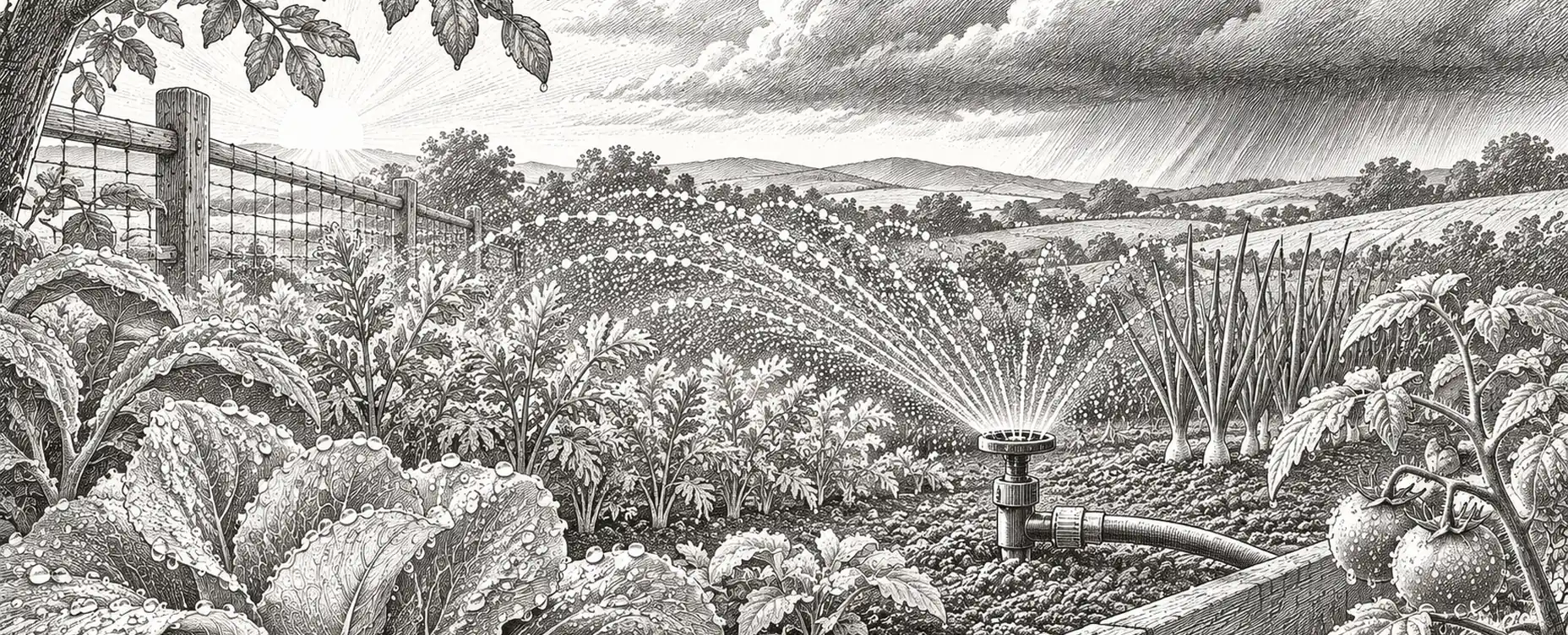
An irrigation timer that waters the garden at 7am every day is watering it during a downpour and watering it in a drought at exactly the same rate. It is also, in most gardens, watering too often and too shallowly, which produces plants with shallow roots that need more water still.
Weather-responsive irrigation fixes both problems, and it is one of the clearest cases where automation does something a person realistically cannot — because nobody is going to check the forecast and adjust a valve every morning for twenty years.
Water deeply and less often
The horticultural principle matters more than any hardware, so it comes first.
Frequent light watering keeps the top few centimetres of soil damp and the rest dry. Roots grow where water is, so plants develop a shallow root system and become dependent on you. Watering less often but more thoroughly encourages roots downward, where soil moisture is more stable, and the plant becomes far more resilient to a missed week.
In practice that means most established beds and lawns want a good soak every few days rather than a daily sprinkle, and the exact interval depends on soil.
Sandy soil drains fast and holds little, so it needs more frequent, smaller applications. Clay holds a great deal but accepts it slowly — water it too fast and it runs off rather than in, so a long slow application or two shorter cycles separated by half an hour works far better. Loam sits happily in between.
This is why a single “watering time” setting is a poor tool and why zones matter.
Water early, and at the roots
Early morning is the best time, for three reasons: evaporation losses are lowest, foliage dries during the day rather than staying wet overnight, and water pressure is often better before general demand rises. Evening watering is the second choice and encourages fungal disease on leaves in humid conditions.
Midday watering is the worst, mostly through evaporation before the water reaches the root zone.
As for method, drip irrigation and soaker hoses deliver water to the soil with very little loss, and they are considerably more efficient than sprinklers — often dramatically so in wind. Sprinklers make sense for lawns and little else. Any spray system loses a large fraction to evaporation and drift on a warm breezy day, which is precisely when you are most tempted to run it.
The sensors that make it intelligent
A rain sensor is the cheapest useful addition and in some countries is a requirement on new systems. It simply prevents a cycle running during or shortly after rain. Crude, and it eliminates the most visible waste.
Soil moisture sensors are the honest measurement, since they tell you the state of the thing you are trying to manage rather than inferring it. Two cautions: place them in the root zone at the depth that matters, typically 15 to 30 cm for beds and shallower for lawns, and expect cheap resistive probes to corrode within a season. Capacitive sensors last far longer and are worth the difference.
A rain gauge, so you can decide based on how much rain fell rather than whether it rained. Five millimetres and thirty millimetres are entirely different events and a binary rain sensor treats them alike.
Temperature, humidity, wind and solar radiation, which together allow an evapotranspiration estimate — the combined water lost from soil by evaporation and from plants through their leaves, usually written ET. This is the professional approach: instead of guessing, you calculate roughly how much water the garden used and replace that amount.
Many weather-based controllers now fetch ET figures from a forecast service rather than measuring locally, which is a reasonable compromise if you have no weather station, and less accurate if your garden differs from the nearest station — a walled, sheltered, shaded garden behaves quite differently from an exposed one two kilometres away.
Zoning, which is where the real savings are
A single zone treats a shaded fern bed and a south-facing lawn identically, and one of them is always wrong.
Sensible zoning groups plants by water need, sun exposure and soil, and it typically produces something like: lawn, which needs a lot and tolerates drying; established shrubs and trees, which need very little once settled; new planting, which needs consistent attention for a season or two; vegetable beds, which need steady moisture and reward drip lines; and pots and containers, which dry out enormously faster than beds and are the commonest casualty of a holiday.
Containers deserve their own zone and their own frequency. A terracotta pot in full sun can need water daily in summer while the bed beside it is fine for a week.
Practical automation rules that work
Skip if it rained more than a threshold in the last 24 hours, using a gauge figure rather than a binary sensor.
Skip if significant rain is forecast in the next 12 hours. Forecasts are imperfect and the cost of being wrong is one dry day, which most gardens tolerate easily.
Skip if soil moisture is above target, which is the most reliable rule if you have the sensor.
Do not water below about 4 °C, and drain or shut down before the first frost. Water in pipes freezes, and split manifolds are a spring ritual for people who forget.
Split long cycles on clay into two shorter runs half an hour apart, so water soaks in rather than running off.
Reduce rather than skip in a heatwave, resisting the temptation to double everything — more frequent shallow watering in extreme heat is exactly the wrong response, and a deep soak at dawn is right.
Alert on anomalies. A zone that runs but shows no flow, or runs continuously, means a stuck valve or a burst line. A flow meter turns a slow leak from a water bill surprise into a notification.
Rainwater harvesting, briefly
Rainwater is free, unchlorinated, slightly acidic and preferred by most plants, and a butt is the least sophisticated and most useful piece of garden water technology available.
Two practical notes for automation. A level sensor in the butt lets a controller prefer stored water and fall back to mains when it runs low, which is the arrangement worth building. And a pump is needed for any drip system, since gravity from a butt rarely provides enough pressure for emitters to work evenly.
Do not use stored rainwater on edible crops close to harvest if the collecting roof is questionable, and keep butts covered to exclude light and insects.
Where people go wrong
Watering the lawn at all. Established lawns in temperate climates go brown in drought and recover. Watering them is the single largest domestic garden water use and largely optional.
Trusting a forecast for a microclimate. If your garden is walled, shaded or on a slope, local measurement beats a regional forecast.
Leaving new planting on the established schedule. New trees and shrubs need consistent water for one or two full growing seasons, and the commonest cause of a failed tree is a schedule that treated it as mature.
Ignoring the water regulations. Many countries require backflow prevention on any irrigation connected to mains supply, precisely so garden water cannot siphon back into drinking water. This is a legal requirement in most places, not an optional extra, and it is a plumber's job.
Forgetting winterisation, which is how a working system becomes a set of split fittings.
Where to start
- Put a rain gauge and one soil moisture probe in first, and watch for a few weeks before automating anything.
- Zone by water need, with containers separated out.
- Convert beds to drip and keep sprinklers for lawn only, if at all.
- Water at dawn, deeply, less often.
- Add rain and forecast skip rules, then a soil moisture rule once you trust the readings.
- Add a flow meter so failures announce themselves.
- Diarise winterisation as a recurring task, because you will not remember.
Step one is the one worth insisting on. Most people over-water substantially, and a fortnight of soil moisture data is usually enough to prove it.