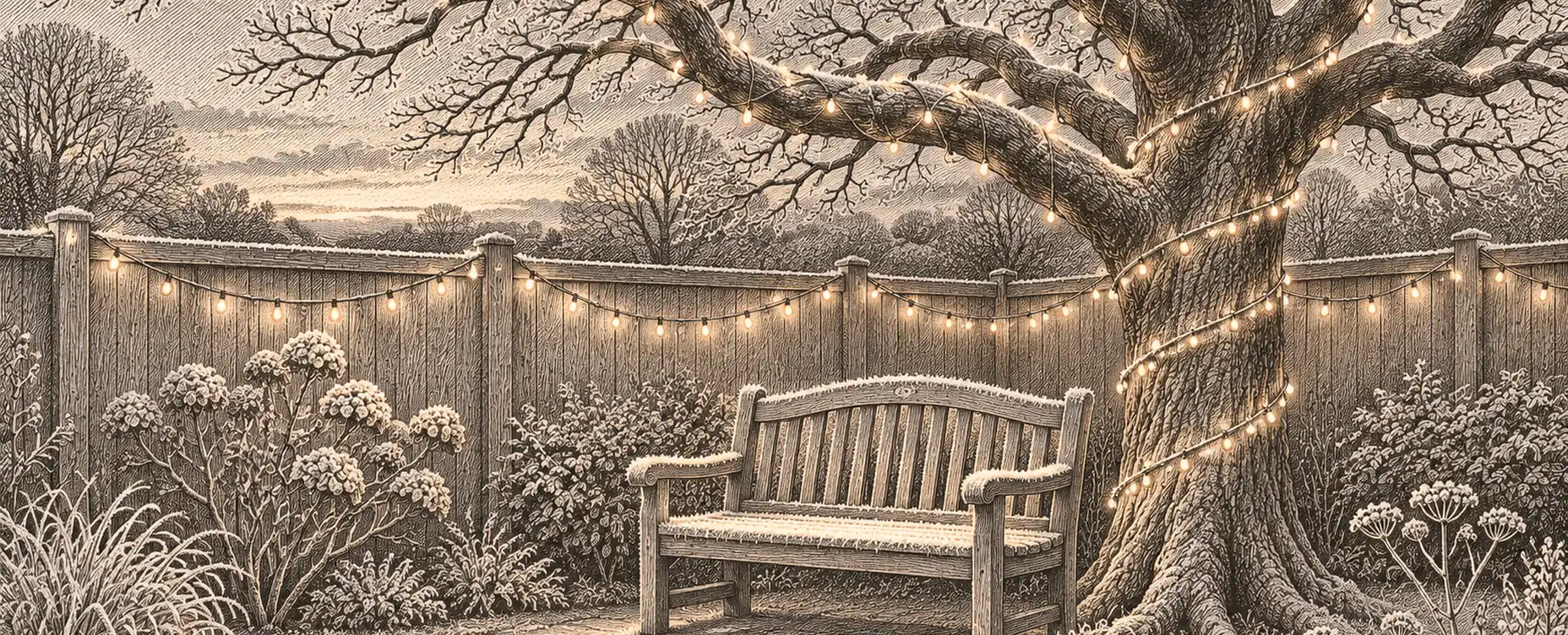
Seasonal lighting is the one time of year when a great many households put a large number of lights up quickly, often outdoors, often on extension leads, and often forget about them for six weeks. It is also, unsurprisingly, a period when electrical incidents rise.
None of what follows is complicated. It is the practical version of doing it well, safely and cheaply.
Safety first, because this is where the risk is
Use outdoor-rated lights outdoors. Indoor sets used outside are a genuine hazard, and the distinction is on the box. Look for an IP rating — IP44 as a bare minimum for anything sheltered, IP65 for exposed positions.
The transformer and connections must be rated too. A set of outdoor lights plugged into an indoor extension lead sitting on the patio defeats the whole arrangement. Use outdoor-rated connectors, or bring the connection indoors through a window or an existing outdoor socket.
Use a residual current device on any outdoor circuit. Modern installations have one covering the socket; if you are unsure, a plug-in RCD adaptor is inexpensive and worth it.
Do not overload. LED sets draw very little, which is why they can be chained — but only up to the manufacturer's stated limit, which exists because the connectors and the first set's wiring carry the whole current. Chaining ten sets rated for three is exactly how the first connector melts.
Inspect before use. Cables cracked from a year in a cold loft, chewed by rodents, or with a damaged plug. This takes two minutes and is the single most useful check.
Do not run cables under carpets or through doorways that close on them.
Real trees: keep them watered, because a dry tree is a serious fire risk, and keep lights away from the trunk base where water sits.
Running cost, honestly
LED seasonal lighting is genuinely cheap to run, and the numbers are worth having because people either worry unnecessarily or overestimate the saving from switching them off.
A typical LED string of a few hundred lamps draws somewhere in the range of 5 to 20 watts. Run for six hours a day over six weeks, that is well under a couple of kilowatt-hours — a matter of cents to a euro or so at typical rates for the whole season.
Old incandescent sets are a different matter entirely, drawing perhaps 200 to 400 watts for the same string, which over a season becomes a genuine cost as well as a real heat and fire consideration. If you still have incandescent sets, replacing them is the one upgrade that clearly pays.
Where the cost actually creeps in: inflatable figures with a continuously running fan, and projectors and animated displays, which draw considerably more than a light string and often run for longer. Those are worth putting on a metering plug once, just to know.
Automating it properly
This is a genuinely good use of a smart plug, and it takes five minutes.
On at dusk, off at a fixed hour. Sunset-relative rather than a clock time, so it tracks the season without adjustment — which matters because sunset moves by nearly an hour across December and January in northern Europe.
Off overnight, both for safety and because nobody is looking at them at 3am. Late evening off, and if you want them for early risers, a short morning window before sunrise is more useful than all night.
One switch for everything. Interior tree, exterior lights, window candles, all on one scene or one voice command, so nobody has to crawl behind furniture.
A physical control. A button by the door or on the mantelpiece, because guests and children want to turn the tree on and should not need an app.
Do not run them while away for days, whatever the temptation to look occupied. Use ordinary interior lamps for that, which is what the occupancy automation is for.
Take the plug and schedule down in January, or you will find a stray automation switching on an empty socket in July. Diarise the removal.
Getting it to look good
A few things separate a display that looks considered from one that looks like a jumble.
Pick one colour temperature and stick to it. Mixing warm white and cool white sets in the same view is the commonest reason a display looks cheap. Warm white, around 2,200 to 2,700 K, reads as traditional and flatters brick and greenery.
Fewer, better sets. A dense high-quality string on one tree looks better than sparse strings on five.
Light shapes, not surfaces. Outlining a roofline, wrapping a trunk, filling a specific tree — these read clearly. Lights scattered across a facade do not.
Dim it. Seasonal lighting is almost always too bright, and a dimmable set at 50 per cent looks warmer and more inviting. Check the set is actually dimmable first, since many are not.
Avoid flashing modes facing a road or a neighbour's window, which is where seasonal lighting becomes an annoyance and occasionally a formal complaint.
Be a good neighbour. Aim outdoor lighting at your own property, keep it out of bedroom windows, switch it off at a reasonable hour, and remember the wildlife point: warmer, dimmer and shorter is better for insects and nocturnal animals as well as for your neighbours.
Battery and solar sets
Battery-operated and solar seasonal lighting has improved and both have limits worth knowing before you rely on them.
Battery sets are ideal for a wreath, a window, a mantelpiece or anywhere with no socket, and they are inherently safer outdoors because there is no mains connection. The trade is runtime: a set on a timer for six hours a night will typically need cells replaced during the season, and cold weather cuts capacity sharply. Use lithium cells rather than alkaline outdoors, and check for a set with a built-in timer so you are not switching it manually every evening.
Solar sets are appealing and, in northern Europe in December, ask a lot of a small panel. Daylight is short, often overcast, and the panel is frequently mounted where it catches very little. Expect a couple of hours after dusk rather than all evening, and site the panel where it gets genuine direct sun rather than tucked behind the hedge it is lighting. A set with a replaceable battery will last several seasons; one with a sealed cell usually will not.
Neither integrates with a home system, which is fine — for anything you want scheduled centrally, mains with a smart plug is the simpler answer.
Storage, which decides next year
Half the frustration of seasonal lighting is untangling it.
Wind each set onto something rigid — a piece of cardboard, a reel, an offcut of pipe. Never a loose ball.
Label each set with where it goes and how long it is.
Store somewhere dry and not extremely cold. A damp shed or an unheated loft degrades insulation and corrodes connectors, and lithium batteries in any battery-operated decorations should not be left in a freezing space.
Remove batteries from battery sets before storage, because leaking cells ruin them.
Bin anything damaged rather than storing it for the year you fix it.
A five-minute setup
- Inspect every set for damaged cable and plugs before it goes up.
- Check outdoor sets are outdoor rated, connections included.
- Count the chaining limit and do not exceed it.
- Use an RCD-protected outdoor socket.
- Put everything on one smart plug or scene, on at sunset, off late evening.
- Add a physical button so anyone can switch the tree on.
- Pick one colour temperature and dim it.
- Diarise removal of the schedule along with the lights.
Items one and five between them cover the safety and the convenience, and both take longer to read about than to do.