Cleaning and turnaround: the operational data that helps
Guests forgive a dated kitchen. They do not forgive a missed bathroom. This is the least visible part of a short-let operation and the easiest to improve.
Guests forgive a dated kitchen. They do not forgive a missed bathroom. This is the least visible part of a short-let operation and the easiest to improve.
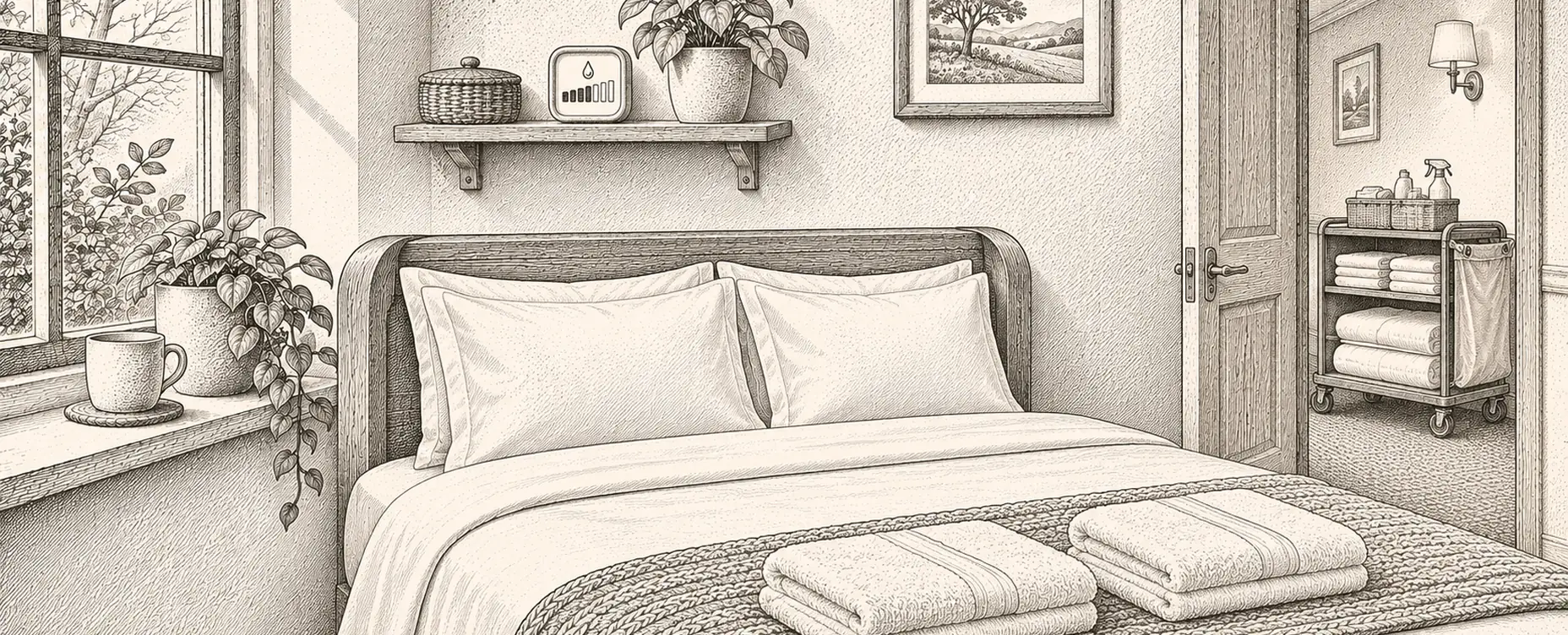
Cleaning and turnaround is where short-let operations succeed or fail. Guests forgive a slightly dated kitchen and do not forgive a bathroom that was missed, a bed that was not made, or arriving to find the previous guest's towels.
It is also the part of the operation with the least visibility, especially for hosts who are not on site. A small amount of sensing changes that, and the useful measures are unglamorous.
Four questions, and none of them is answered by a booking calendar.
Has the guest actually left? Checkout time is a policy, not an observation. Guests leave early, leave late, or leave and come back for a bag.
Did the cleaner arrive, and when? Usually known only from a message, which arrives when the cleaner remembers.
Did the clean cover the whole property? The awkward question nobody asks directly.
Is the property actually ready? Heating on, temperature reasonable, nothing broken, nothing leaking.
Answering these turns turnaround from a sequence of hopeful messages into something you can see.
Knowing the property is empty is the single most useful signal in a short let.
The door lock plus motion is the reliable combination: front door opened, then no movement anywhere for thirty minutes, means empty. Either signal alone is unreliable — a door opening might be someone taking out rubbish, and stillness might be a guest asleep.
Add a grace period generously. Declaring a property empty too early and dispatching a cleaner into an occupied flat is considerably worse than waiting an extra half hour.
Then act on it: notify the cleaner that the property is free, drop heating to a setback, close the water shut-off if you use one, and start the ventilation cycle that airs the place before the next arrival.
Early departure is a genuine operational win. A guest leaving at 7am rather than 11 gives a cleaner four extra hours, which on a busy changeover day is the difference between rushed and thorough.
This needs care, because cleaners are workers with privacy rights and treating them as suspects is both wrong and counterproductive.
The approach that works: motion sensors in every room, reporting that rooms were entered, with no identification and no imaging. A clean that shows activity in the kitchen, both bedrooms and the bathroom looks like a clean. One showing activity only in the hallway and one bedroom is worth a conversation.
Two important framings. Tell your cleaners the sensors exist and why — covert monitoring of workers is unlawful in many jurisdictions and destroys trust in all of them. And present it as protection for the cleaner as much as verification, which is genuine: when a guest claims the property was dirty, room-by-room activity data with timestamps is evidence that the work was done.
What not to do: cameras of any kind inside the property, which is banned by platforms and unlawful in many places regardless of who is being recorded.
The most common complaint about a property that was cleaned properly is that it smells — of the previous guest, of cooking, of damp, of the cleaning products.
What helps, and most of it is automatic:
A purge cycle after departure. Extract fans on full, and if you have controllable ventilation, run it hard for an hour or two while the property is empty. Free, and it makes more difference than any air freshener.
Humidity-triggered bathroom extraction running until baseline, which prevents the mould that produces a musty smell over weeks.
Do not let a property sit sealed and unheated between bookings, which is exactly how a flat develops a smell. A frost minimum plus periodic ventilation keeps it fresh.
Monitor humidity between bookings, because a rising baseline in an empty property is the early warning for a problem you will otherwise meet as a review.
Check the drains. An unused property dries out traps, and a dry trap admits drain odour directly. Running the taps and flushing during a long gap is a small item on a cleaner's checklist that prevents a specific and common complaint.
The failures that generate reviews are rarely dramatic.
Track what runs out — bin liners, toilet roll, coffee, dishwasher tablets, batteries in remotes. A simple per-turnaround checklist with a restock threshold prevents the arrival with no toilet paper.
Track consumable life on equipment: filter changes, water softener salt, extractor filters, smoke alarm dates. Based on run hours rather than a calendar where possible.
Batteries. A property full of sensors, locks and remotes has a lot of batteries, and in an unoccupied property nobody notices a flat one. This is what the sensor health report is for.
Appliance fault detection. A fridge that stopped cycling, a boiler that failed to fire, a washing machine that never completed. Better to know on Tuesday than from a guest on Friday.
A practical observation: the properties that run well are the ones where the cleaner is treated as a partner with useful information, not a task to be verified.
Give them their own lock code. Named, time-windowed, revocable. It protects them as much as you — when something goes missing, a log showing they arrived at 11 and left at 13 is their alibi.
Give them a way to report problems easily. A single message thread, or a simple form, rather than expecting a phone call. Most maintenance issues in a let are first noticed by a cleaner, and whether they get reported depends entirely on how easy it is.
Pay for the time the property actually needs. A flat rate per clean on a property that had six guests and a dog produces a rushed clean, which produces a review. Departure data showing occupancy and duration is a fair basis for paying more when more is needed.
Do not use sensor data punitively on a single occasion. A room with no recorded motion may mean the door was propped and the sensor missed a quick pass. Look for patterns over weeks, and open a conversation rather than an accusation.
Tell them about faults you detected, so they are not blamed for a problem the building caused — a damp patch that a humidity sensor saw coming is not a cleaning failure.
One automated summary after each turnaround, sent to whoever manages the property, containing:
Guest departure time, actual rather than scheduled.
Cleaner arrival and departure, from lock code use.
Rooms with recorded activity during the clean.
Current temperature and humidity in each room.
Water and electricity used by the previous booking, flagged if unusual.
Any sensor that has not reported in the last week.
Any appliance that did not behave normally.
Property status: ready or not.
That is a single message replacing several exchanges, and it turns the state of a property you cannot see into something you can act on before the next guest arrives rather than after.
Item one enables most of the others, and item eight is the one that keeps the whole arrangement honest — a property full of sensors that stopped reporting in March is worse than one with none, because you believe you are covered.