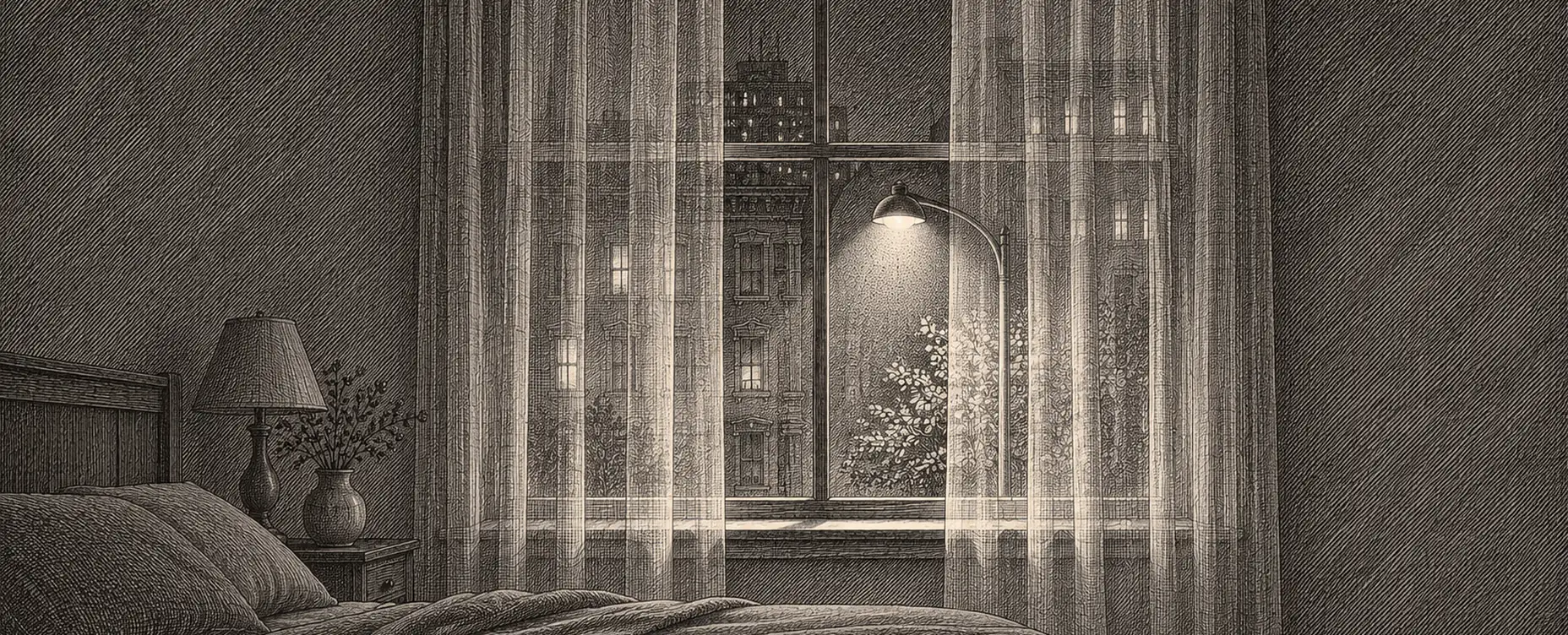
Noise and light are the two environmental factors people put up with for years without measuring, partly because you adapt to them and partly because there is no obvious number to check. Both have reasonable evidence linking chronic exposure to poorer sleep and, over long periods, to broader health effects — and both are more tractable at home than people assume.
Here is what is worth measuring, what the figures mean, and what actually reduces them.
Noise: the numbers, briefly
Sound level is measured in decibels, on a logarithmic scale, usually A-weighted — written dB(A) — which adjusts for how human hearing responds across frequencies.
Logarithmic means the arithmetic is not intuitive. A 10 dB increase is roughly a doubling of perceived loudness, and a 3 dB increase is a doubling of actual sound energy. Two identical noise sources are 3 dB louder than one, not twice as loud.
For orientation:
- 30 dB(A): a quiet bedroom at night.
- 40 dB(A): the WHO night-time guideline for outside bedroom windows in its environmental noise guidance, above which sleep effects become measurable.
- 50–55 dB(A): ordinary conversation, a quiet street. Guidance for daytime residential exposure sits in this region.
- 70 dB(A): a busy road at close range, a vacuum cleaner.
- 85 dB(A): the level at which occupational hearing protection typically becomes required, for sustained exposure.
The important distinction for sleep is between average level and events. A steady 40 dB is far less disruptive than a quiet room punctuated by a 60 dB lorry every twenty minutes, because it is the change that causes arousal. If you measure, look at the peaks rather than only the mean.
Measuring it honestly
Phone apps and cheap meters are useful for relative comparison and unreliable for absolute figures, because microphone response and calibration vary widely. Some smart speakers and air quality monitors report a sound level, which is fine for trends.
What you actually want to know is usually comparative: is the back bedroom quieter than the front? Does the peak coincide with the first bus? Does the neighbour's heat pump run at 2am? Those questions do not need calibrated equipment, and logging over a week answers them far better than standing in a room feeling annoyed.
If you need figures for a formal complaint, that is a different matter. Environmental health departments in most countries can measure properly, and their data carries weight yours will not.
Reducing noise, in order of effectiveness
Deal with the source. Obvious and frequently possible: a rattling extractor, a boiler pump, a washing machine on an uneven floor, a fridge against a party wall, an outdoor unit mounted on a wall that transmits vibration into the house. Anti-vibration mounts are cheap and remarkably effective for mechanical noise.
Fix the gaps. Sound follows air. A letterbox, a keyhole, a gap under a door, an unsealed window frame or a trickle vent leaks sound disproportionately, and sealing air gaps is the cheapest meaningful improvement available. Note the tension with ventilation — the answer is usually acoustic vents rather than blocking ventilation, which causes the damp problems described elsewhere on this site.
Add mass. Sound reduction through a structure depends chiefly on mass. Heavy curtains help a little; secondary glazing with a wide air gap helps a great deal, often more than replacement double glazing, because the gap width matters more than the pane count.
Then absorb and mask. Soft furnishings, rugs and bookshelves reduce reverberation inside a room, which makes it more comfortable without reducing what comes in. Masking sound — a fan, broadband noise — reduces the contrast that causes waking, and for many people it is the most effective bedroom intervention available for the least money.
What does not work: acoustic foam on a wall, which absorbs high frequencies inside the room and does essentially nothing to block traffic noise coming through it. This is the commonest misconception in domestic acoustics.
Light pollution, indoors and out
Two separate problems get conflated here.
Light entering the bedroom disrupts sleep and suppresses melatonin. Street lighting, security lights, a neighbour's floodlight and your own standby LEDs all contribute. Blackout blinds fitted to the reveal rather than hung over it, and a piece of tape over indicator lights, solve most of it for very little.
Light your house emits affects your neighbours, local wildlife and the night sky. Outdoor lighting is where domestic installations most often overreach, and the fixes make the lighting better rather than worse.
Four principles cover it. Point light down, using shielded fittings, so it illuminates the ground rather than the sky and the neighbour's window. Use only as much as needed — over-bright security lighting creates glare and deep shadow, which makes it harder to see, not easier. Use warmer colour temperatures, since cold blue-white light scatters more, causes more glare and has more effect on insects and wildlife. And switch it off or trigger it on motion rather than running it all night, which is both more effective as a deterrent and dramatically cheaper.
Where automation genuinely helps
Motion-triggered outdoor lighting at modest brightness, off by default. Better deterrent, less light pollution, lower running cost.
Circadian indoor lighting — cooler and brighter in the morning, warmer and dimmer through the evening. This is one of the few smart lighting features with a clear rationale rather than a novelty one.
Standby light suppression, by putting the offending devices on a switched circuit that is off at night.
Automatic blinds closing at dusk, which handles both light entering and privacy, and is more reliable than remembering.
Noise logging with an alert, if you have a dispute. A week of data showing peaks at 2:15am most nights is far more persuasive than a description, and it tells you whether your impression matches reality — sometimes it does not, which is also worth knowing.
Quiet hours for your own machines. Scheduling the dishwasher and washing machine to avoid the small hours is courteous where you share walls, and it conflicts with cheap-rate tariff optimisation. Worth resolving deliberately rather than discovering through a note from a neighbour.
Neighbour noise, which is mostly not a technical problem
The largest single source of domestic noise complaint is other people, and hardware helps least here.
A few observations from experience. Talk first, and early. A great many noise disputes escalate because the first contact was a formal complaint rather than a conversation, and people who did not know they were audible usually adjust. Flats built before modern acoustic regulations transmit far more than their occupants imagine.
Impact noise is different from airborne noise. Footsteps, dropped objects and furniture moving travel through structure rather than air, which is why they are unaffected by heavy curtains or sealed gaps. The fix is at the source — rugs, underlay, felt pads on furniture legs — and it is far cheaper for the person upstairs to fit a rug than for you to rebuild a ceiling.
Log before you complain, then log after. Data serves you in two directions: it makes a genuine complaint credible, and it occasionally shows that the problem is less frequent than it feels at 3am, which is worth knowing before a relationship with a neighbour is damaged permanently.
A week-long experiment
- Log sound level in your bedroom for a week, and look at peaks rather than averages.
- Photograph your bedroom at 2am with the lights off. Cameras reveal light sources your adapted eyes have stopped noticing.
- Tape over every indicator LED and fit blackout to the reveal.
- Identify your loudest recurring event and find its source. Mechanical noise inside the house is usually fixable in an afternoon.
- Seal the air gaps on the noisy side, using acoustic vents rather than blocking ventilation.
- Try masking sound before spending anything on glazing.
- Turn your own outdoor lighting down, aim it at the ground, and put it on motion.
Steps two and three take twenty minutes and are the ones people report the biggest difference from, which says something about how easily we stop noticing our own environment.