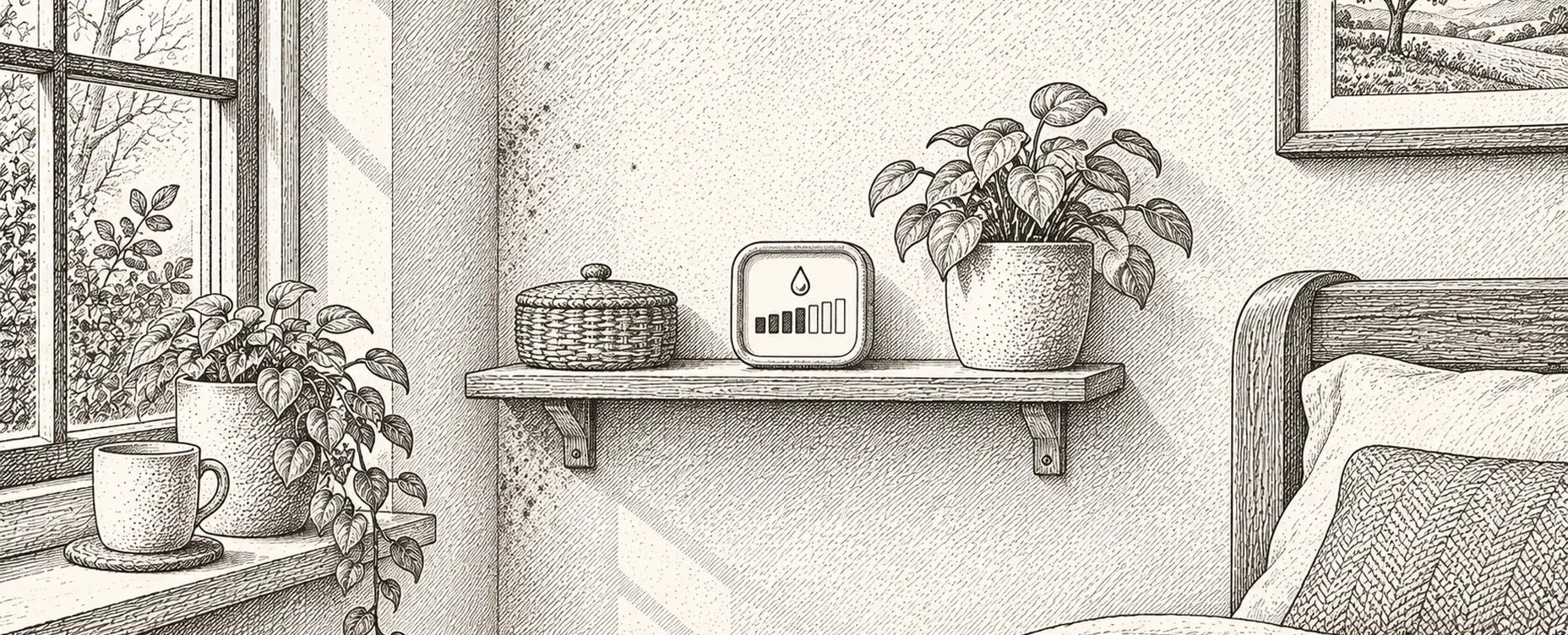
Damp and mould are among the most common problems in housing and among the most misunderstood. The usual response — wipe it off, repaint, buy a dehumidifier — treats the symptom. The cause is almost always a relationship between three things you can measure for very little money: how much moisture is being produced, how cold the coldest surface is, and how much air is moving through.
Get those three numbers and the problem usually becomes obvious. Here is how to read them.
Why mould grows where it grows
Mould needs moisture, and it gets moisture when humid air meets a cold surface. Warm air holds far more water vapour than cold air, so when that air touches a cold wall, window reveal or the back of a wardrobe on an external wall, its relative humidity at that spot rises sharply even though the room average looks fine.
Two terms are worth knowing because they explain everything else.
Dew point is the temperature at which air becomes saturated and water condenses out. It depends on temperature and humidity together. Air at 20 °C and 60 per cent humidity has a dew point around 12 °C — so any surface colder than 12 °C in that room will get wet.
Thermal bridge is a part of the building fabric that conducts heat outward faster than its surroundings — a concrete lintel, a steel beam, an uninsulated reveal, a corner where two external walls meet. These are the cold spots, and this is why mould appears in the same corners in house after house rather than at random.
So mould in a corner is not a hygiene failure. It is a measurement telling you that surface is below the dew point of the air in that room.
Where the moisture comes from
An average household puts a surprising quantity of water into the air every day, and the sources are ordinary.
- Breathing and perspiring: a sleeping adult releases a meaningful amount overnight, which is why bedrooms and their humidity are so often the problem.
- Showering and bathing, concentrated into a few minutes in a small room.
- Cooking, particularly boiling with lids off.
- Drying laundry indoors, which is the single largest avoidable source in most homes — a full load releases litres of water into the house.
- Unvented tumble dryers that are not condensing types.
- Houseplants and aquariums, in quantity.
Then there is moisture that is not from the air at all: rising damp from the ground, penetrating damp through a defective wall, roof or gutter, and plumbing leaks. These behave differently — they persist regardless of ventilation, often show tide marks or staining rather than surface mould, and no amount of humidity management will fix them. Distinguishing the two is the first diagnostic question.
What to measure, and what good looks like
Relative humidity in every room. Cheap sensors are entirely adequate. A sustained reading above about 65 per cent is a problem; above 70 for extended periods, mould is likely. Below 40 in winter is a different discomfort.
Air temperature in every room. Needed to compute dew point, and revealing on its own — the room with the mould is usually the coldest room, often a spare bedroom nobody heats.
Surface temperature at the cold spots. This is the measurement almost nobody takes and the one that closes the case. An inexpensive infrared thermometer, pointed at the corner where the mould grows, tells you how cold that surface actually is. Compare it with the dew point and you have your answer.
How long the bathroom stays humid after a shower. If it is still above 70 per cent an hour later, your ventilation is inadequate regardless of what the fan is rated at.
The three fixes, in order of effectiveness
1. Produce less moisture. Free, and often sufficient on its own. Dry laundry outside or in a vented or condensing dryer. Lids on pans. Bathroom door closed while showering and for a while afterwards, so the moisture is extracted rather than distributed through the house.
2. Ventilate, at the source and at the right time. Extract in the bathroom and kitchen while moisture is being produced and for a good while after — most fans are switched off far too early. Whole-house background ventilation matters too: purpose-built trickle vents exist for a reason and blocking them causes exactly this problem.
3. Warm the cold surfaces. Counter-intuitively, keeping a problem room slightly warmer and more consistently heated often cures mould, because a warmer surface stays above the dew point. Unheated spare rooms with the door closed are the classic case. The permanent fix is insulation, which raises surface temperature and is the only response that addresses the actual cause.
Dehumidifiers come fourth. They work, they are useful in a specific stubborn room or while drying out after a leak, and running one permanently to manage a problem caused by indoor laundry drying and a blocked vent is an expensive way to avoid two free changes.
Automating it properly
This is a genuinely good automation problem because the correct action depends on comparing two things a human never bothers to compare.
Humidity-triggered extraction. Rather than a timer, run the bathroom fan while humidity is elevated relative to the rest of the house, and stop when it returns to baseline. Using a relative comparison rather than a fixed threshold makes it work in summer and winter alike, which fixed thresholds do not.
Ventilate when outdoor air is drier. Compare indoor and outdoor absolute humidity — the actual mass of water per volume of air — not relative humidity. Cold outdoor air at 90 per cent relative humidity is much drier in absolute terms than warm indoor air at 55 per cent, so opening a window on a cold damp day genuinely dries the house. Relative humidity comparisons get this backwards, and it is the commonest mistake in home ventilation automation.
Dew point alerting. Calculate the dew point in the problem room and alert when the coldest surface is likely to be near it. This turns a vague worry into a specific prompt.
Minimum heating in unheated rooms. A background setpoint of 15 or 16 °C in a spare room costs little and prevents the surface from ever getting cold enough.
When it is not condensation
Some patterns point away from humidity and towards building defects, and it is worth recognising them rather than ventilating a leak.
A defined tide mark rising from the floor, with salts or a powdery deposit, suggests rising damp.
A patch that worsens specifically after rain, or appears high on a wall or near a chimney, suggests penetrating damp, a failed gutter or defective pointing.
A localised wet spot near pipework is a leak.
Damp that does not respond at all to ventilation and heating over several weeks is structural.
These need a builder or a surveyor, and in rented property they are generally the landlord's responsibility — documented humidity and temperature logs are unusually persuasive evidence in that conversation, which is a practical argument for cheap sensors in itself.
A one-week diagnostic
- Put a temperature and humidity sensor in every room, including the cold spare one, and leave them for a week.
- Point an infrared thermometer at the mould on a cold morning and note the surface temperature.
- Compute the dew point for that room from its air temperature and humidity. If the surface is below it, you have condensation and the cause is now known.
- Stop drying laundry indoors for that week and watch the numbers.
- Time how long the bathroom takes to return to baseline after a shower.
- Then act — source reduction, ventilation, surface warmth, in that order.
Almost every household that does step four sees a change in the numbers within days, and it is the cheapest experiment in this entire article.