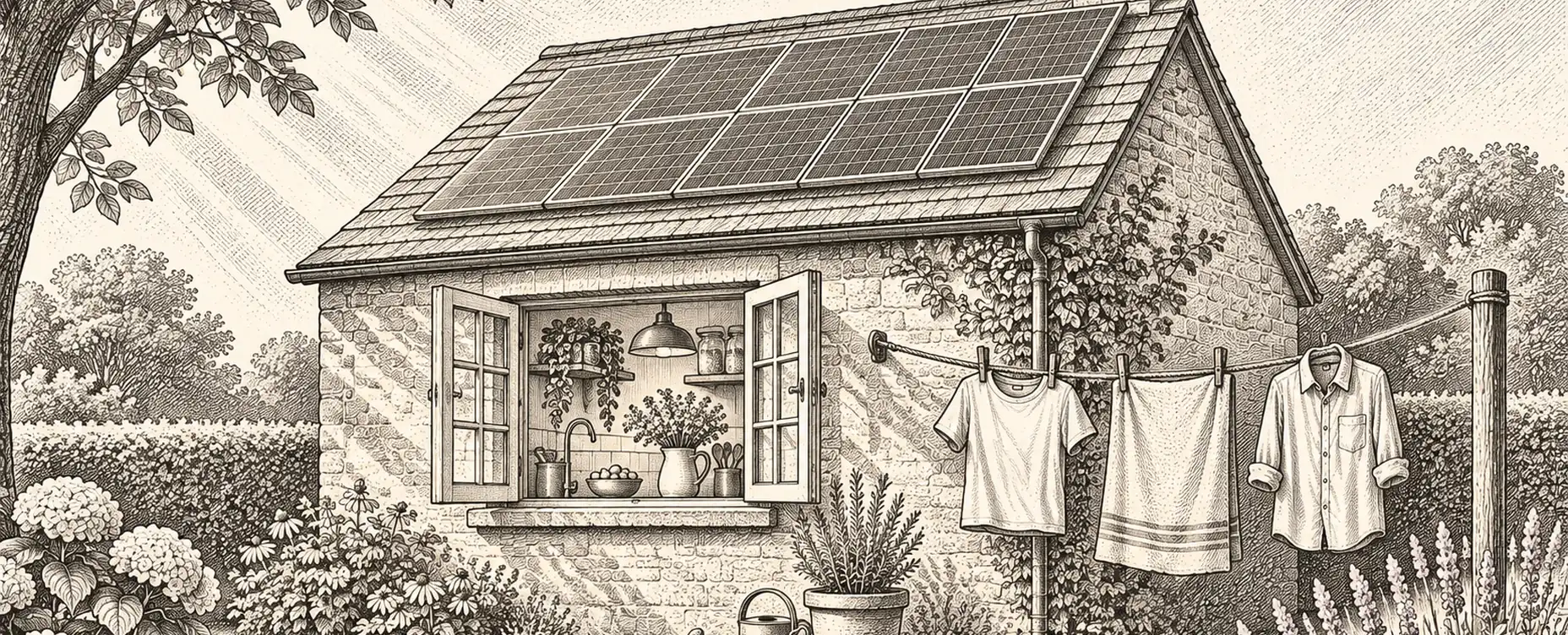
Solar panels are the most visible domestic energy investment and the most misunderstood. The confusion is rarely about how they work. It is about what happens to the electricity you generate and do not use at that moment, because that single question determines almost all of the economics.
Self-consumption is the whole game
Every kilowatt-hour your panels produce goes one of two places: you use it, or it goes to the grid.
Electricity you use yourself saves you the full price you would have paid, including all the network charges and taxes. Electricity you export earns you whatever your export arrangement pays, which in most markets is considerably less than the import price.
So the value of a solar installation depends heavily on the fraction you consume yourself — the self-consumption rate. A house where everyone is out all day and the panels export most of their production earns far less than an identical installation on a house where somebody is home, the dishwasher runs at noon and the car charges in the afternoon.
This has a direct implication that surprises people: using more electricity during the day can improve your finances, provided it is electricity you were going to use anyway, moved from evening to midday.
The net metering question
The single biggest variable in solar economics is how your country treats exported power, and it is changing.
Net metering credits exported electricity at the same rate you pay for imports, effectively using the grid as a free battery. Where it exists, self-consumption barely matters financially, because a kilowatt-hour exported at noon offsets one imported at eight in the evening.
Where net metering is being reduced or ended — the Netherlands has been phasing its arrangement out, and several other countries have already moved — exported power earns a much lower rate, and self-consumption suddenly becomes the dominant factor. This is precisely why home batteries have become interesting in markets where they previously were not.
Find out the current position in your country, and specifically what happens over the lifetime of the panels. A twenty-five-year asset outlives most policy arrangements.
Raising self-consumption without a battery
Worth doing first, because it costs almost nothing.
Move the shiftable loads to daylight
Dishwasher, washing machine and dryer scheduled for the middle of the day rather than the evening. Straightforward, and on a sunny day it is free electricity instead of bought electricity.
Divert surplus to hot water
The single most effective non-battery measure. A solar diverter senses export and pushes it into an immersion heater instead of selling it. A hot water cylinder is a heat battery that costs a fraction of an electrical one, and hot water is a load every household has.
Get the control right: a hysteresis band and a minimum run time, so the element does not chatter on and off with every passing cloud, and cut out on cylinder thermostat temperature rather than a timer.
Charge the car during the day, when you can
Only useful if the car is home in daylight, which for many households it is at weekends. A charger with a solar surplus mode will follow generation and pause when a cloud passes.
Pre-heat or pre-cool the house
On a sunny winter afternoon, running the heat pump harder than needed while power is free and letting the house coast into the evening is genuine storage in the building fabric. It works best in well-insulated houses.
What affects output, and by how much
Worth knowing before believing a quotation.
Orientation and pitch. South-facing is optimal in the northern hemisphere; east and west face lose some annual yield but spread production across morning and evening, which frequently improves self-consumption. An east-west split can be the better financial choice even with lower total output.
Shading. The most damaging factor and the most often glossed over. With a string inverter, shade on one panel drags down the whole string. Micro-inverters or optimisers mitigate it at extra cost. If you have a chimney, a tree or a neighbouring building, insist that the quote addresses it specifically.
Temperature. Panels are less efficient when hot, which is why peak output often occurs on a cool bright day rather than the hottest one.
Soiling. Dust, pollen and bird droppings reduce output. Rain handles most of it on a pitched roof; flat installations may need occasional cleaning.
Degradation. Panels lose output slowly, typically warranted to retain around eighty per cent after twenty-five years. Real but slow.
Monitoring, and what to actually watch
Most installations come with an app showing generation. Generation alone is the least useful number.
What you want is generation, consumption and the split between self-consumption and export, which requires a bi-directional meter as well as the inverter data. Our energy meter guide covers this. With those three figures you can answer the questions that matter: what proportion am I using, is it worth shifting more load, and would a battery help.
The other thing worth monitoring is whether the system is working at all. Inverter faults and a failed string can go unnoticed for months, and an alert if generation is far below expectation for the conditions is the cheapest possible protection for a substantial asset.
Two things people get wrong when sizing
Oversizing to cover winter. A common instinct is to specify enough panels to meet demand in December. In most of northern Europe that is impossible at any sensible scale, because winter output is a small fraction of summer. Size for a sensible annual yield and self-consumption rate rather than for the worst month, and accept that winter comes largely from the grid.
Ignoring the export limit. Many grid operators cap how much a domestic installation may export, and in some areas a large array requires an application that may be refused or restricted. This is worth establishing before designing a system, because a curtailed array is wasted capital. Where an export limit applies, self-consumption and storage become more valuable rather than less.
It is also worth asking about the point of connection — the physical and electrical boundary where your property meets the public network, which defines the capacity available to you and where the grid operator’s responsibility ends. A property with a modest connection may need it upgraded to support both a large array and an EV charger, and that is a conversation with the network operator rather than the installer.
Where to start
- Find out your country’s export arrangement and what is planned. This determines everything else.
- Reduce your standing load first. Every watt removed is a watt you never need to generate.
- Shift what you can into daylight — wet appliances first, at no cost.
- Add a solar diverter to hot water if you have a cylinder. Best value non-battery measure.
- Monitor generation, consumption and the split, plus a fault alert.
- Only then evaluate a battery, using your own measured self-consumption figure rather than an assumption.
The order is deliberate. Every step before the battery is cheap, and each one changes the answer to whether the battery is worth it.