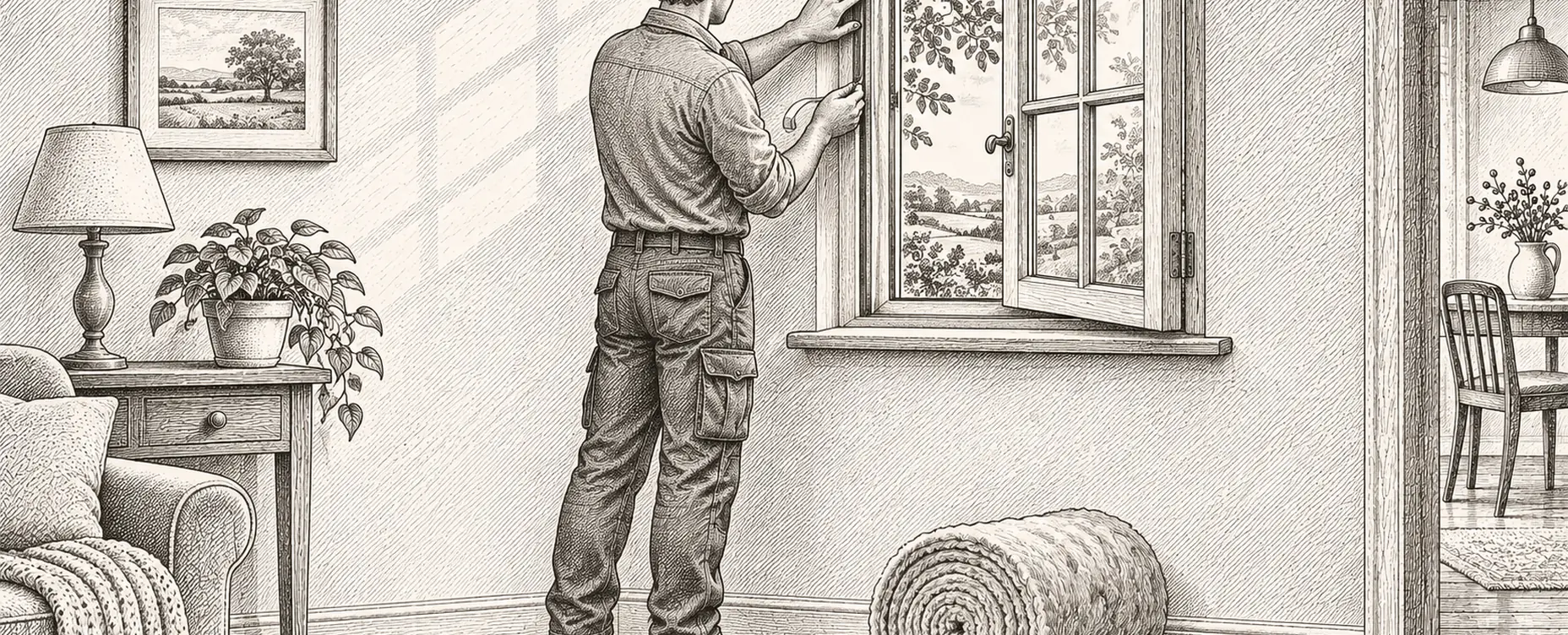
There is an order to reducing a home's energy use, and most households do it backwards. Controls and generation are visible and interesting; insulation and draughtproofing are dull, hidden, and where the returns actually are.
The principle is simple: reduce the demand before you optimise the supply. A well-sealed house needs a smaller heat pump, a smaller radiator, less generation and less clever control. Every step you take on the fabric makes every later step cheaper.
Why fabric comes first
Heat leaves a house by conduction through surfaces and by air movement through gaps. Both scale with the difference between inside and outside temperature, and both run continuously all winter.
Reducing that loss is permanent, requires no maintenance, cannot be switched off by mistake, and does not depend on a company continuing to run a service. There is no other category of energy intervention with those properties.
It also improves comfort in a way that controls cannot. A room loses heat to cold surfaces by radiation regardless of air temperature, which is why a poorly insulated room at 21 °C feels worse than a well insulated one at 19. Insulation lets you be comfortable at a lower thermostat setting, which compounds the saving.
The order that pays
1. Draughtproofing
The cheapest and usually the highest return per pound spent. Uncontrolled air leakage can account for a substantial share of heat loss in an older house, and most of it comes from a small number of places.
Where to look: gaps at skirtings and floorboards, particularly with a suspended timber floor; around window and door frames, where the frame meets the wall rather than the opening part; the loft hatch, which is frequently a bare board over a hole; unused chimneys, which act as permanent extract fans; letterboxes and keyholes; service penetrations where pipes and cables enter; and gaps around extractor fans and vents that are no longer used.
One caution that matters: do not block purpose-provided ventilation. Trickle vents, air bricks serving a suspended floor, and extract fans are there for a reason, and sealing them causes the condensation and mould problems described elsewhere on this site. Seal the accidental gaps; keep the deliberate ones.
2. Loft insulation
Cheap per square metre, easy to top up, and heat rises. Most guidance now points at around 270 to 300 mm of mineral wool, and a great many lofts have half that from an older standard.
Things people get wrong: compressing insulation with boarding, which destroys its performance — use raised loft legs if you need storage; insulating over pipes and tanks, which puts them in cold air and invites freezing; blocking eaves ventilation, which causes condensation in the roof space; and leaving the hatch uninsulated, which is a surprisingly large hole.
3. Cylinder and pipe insulation
Almost free and immediate. A modern factory-insulated cylinder is fine; an older one with a thin jacket loses a great deal. Lagging the first couple of metres of pipe leaving the cylinder is a few pounds and pays back in weeks.
4. Cavity wall insulation, where appropriate
Effective in a suitable cavity and genuinely not suitable everywhere — exposed coastal walls, walls with existing damp penetration, and narrow or debris-filled cavities can all be made worse. This is a case for a proper survey rather than a cold call.
5. Floors, windows and solid walls
Higher cost, longer payback, and worth doing when other work makes access easy. Suspended timber floors can be insulated from below where there is a crawl space, which is often surprisingly effective because that void is ventilated to outside air.
Finding your own losses
You do not need a professional survey to know where your house leaks.
Temperature sensors in every room for a fortnight in cold weather. The room that cools fastest is losing heat fastest, and that is where to look.
An infrared thermometer pointed at walls, ceilings, window reveals and corners on a cold day. Cold spots are thermal bridges or missing insulation, and it costs very little.
A thermal camera, borrowed or hired, used from inside on a cold day with the heating on. This makes losses obvious in a way nothing else does.
The back of your hand, moved slowly around frames, skirtings and the loft hatch on a windy day. Unscientific and remarkably effective.
A smoke pencil or an incense stick, which shows air movement clearly. Do this with extract fans running to depressurise the house slightly and the draughts become obvious.
What the numbers look like
Being honest about magnitudes rather than quoting percentages that depend entirely on the starting point.
In a typical uninsulated older house, heat loss divides roughly between walls, roof, windows, floor and air leakage, with walls usually the largest single share and the roof the cheapest to fix. Air leakage is frequently underestimated and is almost always the cheapest to reduce.
The useful way to think about it: a euro spent on draughtproofing and loft insulation buys considerably more comfort and saving than a euro spent on almost anything else, and that remains true right up to the point where those measures are done properly.
After that, the ranking shifts to depend on your specific house, which is why measurement beats generic advice.
Where this changes your technology decisions
Fabric work is not an alternative to a smart home — it changes what the smart home should be.
Heat pump sizing. A heat pump specified for an uninsulated house is larger, more expensive, and runs at a higher flow temperature. Insulate first and the same house needs a smaller, cheaper, more efficient machine.
Setback strategy. A well-sealed house barely cools overnight, which makes deep setbacks pointless and steady operation easy.
Zoning. Rooms in a leaky house diverge widely; in a tight house they track each other, and simple control works better.
Ventilation. Once a house is genuinely sealed, ventilation must become deliberate. This is the trade you accept, and it is why airtightness and ventilation are a single subject rather than two.
Cooling. Insulation works in both directions, keeping heat out in summer as well as in during winter.
Grants, schemes and being careful about them
Most European countries operate some form of subsidy for domestic insulation, and the schemes change frequently enough that we will not quote specifics.
What is worth knowing in general terms. Check what exists before you commission work, because many schemes require approval or a registered installer before work starts, and retrospective claims are usually refused. Grants often require an assessment, which is useful in itself even if you do not proceed. And the order of measures may be prescribed — several schemes require insulation before they will support a heat pump, which happens to be the right order anyway.
One caution. Insulation has attracted a certain amount of poor practice, particularly around cold-called cavity wall and external wall work. Signals worth heeding: pressure to sign quickly, a survey that takes ten minutes, no discussion of ventilation or existing damp, and a guarantee backed by nobody identifiable. Badly installed wall insulation causes damp problems that cost far more than the heating it saved, so use a registered installer with a meaningful guarantee and get more than one opinion.
An order of work
- Measure every room for a fortnight in winter and note which cools fastest.
- Draughtproof the accidental gaps, leaving purpose-provided ventilation alone.
- Top up loft insulation to current guidance, on legs if you need storage, not over pipes.
- Insulate the hatch, the cylinder and the accessible pipework.
- Get a proper survey before cavity or solid wall work.
- Reconsider your heating controls afterwards, because the right answer will have changed.
- Then think about generation, storage and tariffs, sized against your new and lower demand.
The temptation is always to start at step seven, because it is the interesting one. Doing steps two to four first makes step seven smaller, cheaper and better.