Leak and cycle monitoring for dishwashers and other wet appliances
The appliances most likely to flood a kitchen are also the cheapest to monitor, if the sensor goes in the right place and the hose gets replaced on time.
The appliances most likely to flood a kitchen are also the cheapest to monitor, if the sensor goes in the right place and the hose gets replaced on time.
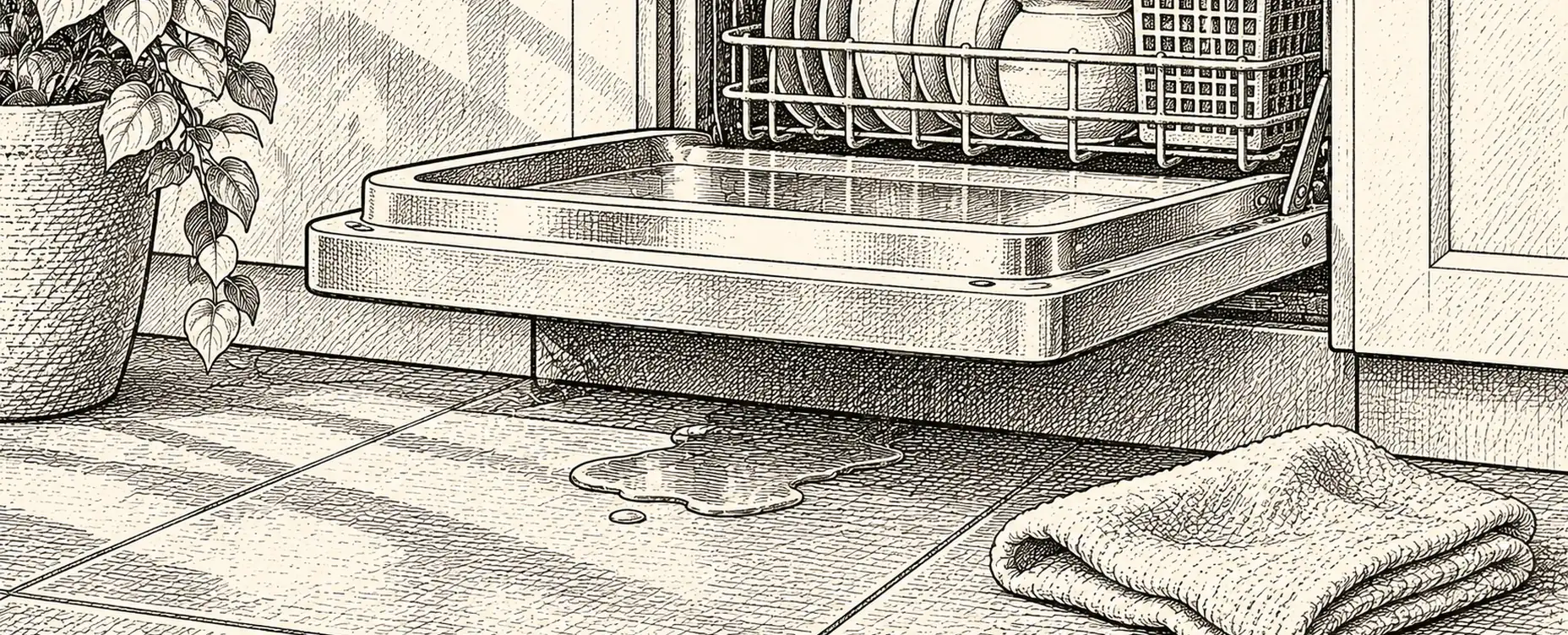
A dishwasher or washing machine sits under mains pressure at every hour of every day, whether it is running or not, connected by a flexible hose that is designed to eventually wear out. That combination — constant pressure, a wear item, and a location often out of daily sight behind or under the appliance — is exactly why these machines feature so heavily in accounts of expensive domestic water damage. It is also, fortunately, one of the cheaper problems in this book to actually solve.
Three things make dishwashers, washing machines and plumbed fridges disproportionately likely sources of water damage compared with, say, a bathroom tap. They are permanently pressurised on the supply side even when idle, unlike a tap that only sees pressure when opened. They are often positioned somewhere a small leak goes unnoticed — behind a machine, under a worktop, against a wall — rather than somewhere visible. And their supply hoses are a genuine wear item, subject to the same pressure cycling and material ageing as any flexible hose under constant load.
None of this is a reason to avoid these appliances. It is a reason to put a small amount of monitoring exactly where it earns the most.
You do not need to buy a network-connected dishwasher to know when a cycle has finished. A smart plug that measures power draw — the same technique covered in our piece on what smart plugs are genuinely good for — sees a dishwasher's distinctive draw pattern rise during the wash and heat phases and drop to near zero once the cycle completes, which is a reliable enough signal to trigger a notification without needing anything built into the machine itself.
This is worth doing independently of the leak-monitoring case below: knowing a cycle has actually finished, rather than guessing, is useful on its own for both washing machines and dishwashers.
The most common mistake is placing a leak sensor somewhere convenient rather than somewhere water would actually reach first. Water follows gravity and the floor, not the shape of the appliance, so the sensor belongs on the floor at the lowest point behind or beside the appliance, not clipped to a pipe or tucked inside a cabinet shelf above floor level.
For an integrated appliance built into cabinetry, where the floor behind it is genuinely unreachable, a sensing cable that runs along the base of the cabinet run and alarms anywhere along its length is a more practical option than a single puck sensor you can never retrieve to test.
This mirrors the general placement principle covered in our piece on leak detection and automatic shut-off: a sensor you cannot reach to test is a sensor you should assume is not working.
A flexible appliance supply hose is designed to be replaced periodically, not left in place for the appliance's entire working life. Braided steel-reinforced hoses are generally more resistant to bursting than plain rubber hoses, though the fitting and rubber seals at each end remain a wear point regardless of the reinforcement, and manufacturers of both types typically recommend replacement on a multi-year schedule rather than only when a hose visibly fails.
Two habits go a long way here: fit isolation valves at the wall for any plumbed appliance if they are not already present, so the supply can be shut off in seconds without finding the main stopcock, and turn that isolation valve off when travelling for more than a few days, which removes the constant-pressure condition entirely for the duration.
A leak sensor that only sends a notification is useful. A leak sensor wired into an automatic shut-off, as covered in our main piece on leak detection and shut-off, is materially more useful, because it acts at 3am when nobody is reading a notification.
The integration is straightforward if the household already has a whole-house shut-off valve: any appliance leak sensor going wet triggers the same valve as any other sensor in the house, rather than needing its own separate response. This is simply a matter of adding the appliance sensor to the existing automation rule, not building anything new.
Beyond the shared supply-hose risk, washing machines add two failure modes dishwashers generally do not. A detergent drawer or seal blockage can cause water to back up and overflow from the top or front of the machine rather than leaking from the supply side at all, which is why a floor-level sensor in front of the machine matters as much as one behind it. And a drain pump or drain hose failure partway through a cycle can empty a full drum onto the floor in one go rather than the slow drip typical of a supply-side leak — a larger, faster event that makes a floor-level sensor's speed of response more important than for a slow weep elsewhere.
Checking that the drain hose is properly secured at the standpipe, rather than resting loosely, is a simple, free check worth doing whenever the machine is moved for any reason.
Worth doing: leak sensing at floor level behind every plumbed appliance, cycle-end notifications for the convenience of knowing when to unload, and isolation valves that get used when travelling. Not worth the complexity for most households: trying to detect a slow, gradual hose failure from power-draw data alone, which is not something a power sensor can see — that is exactly what the floor-level leak sensor is for instead.
Every item on this list is inexpensive. Together they address the specific, well-documented reason these particular appliances feature so often in water damage claims.