Best Buys › Switches & Dimmers
Switches & Dimmers
Replace the switch itself, so the room still works by hand — if your wiring allows it.
Best Buys › Switches & Dimmers
Replace the switch itself, so the room still works by hand — if your wiring allows it.
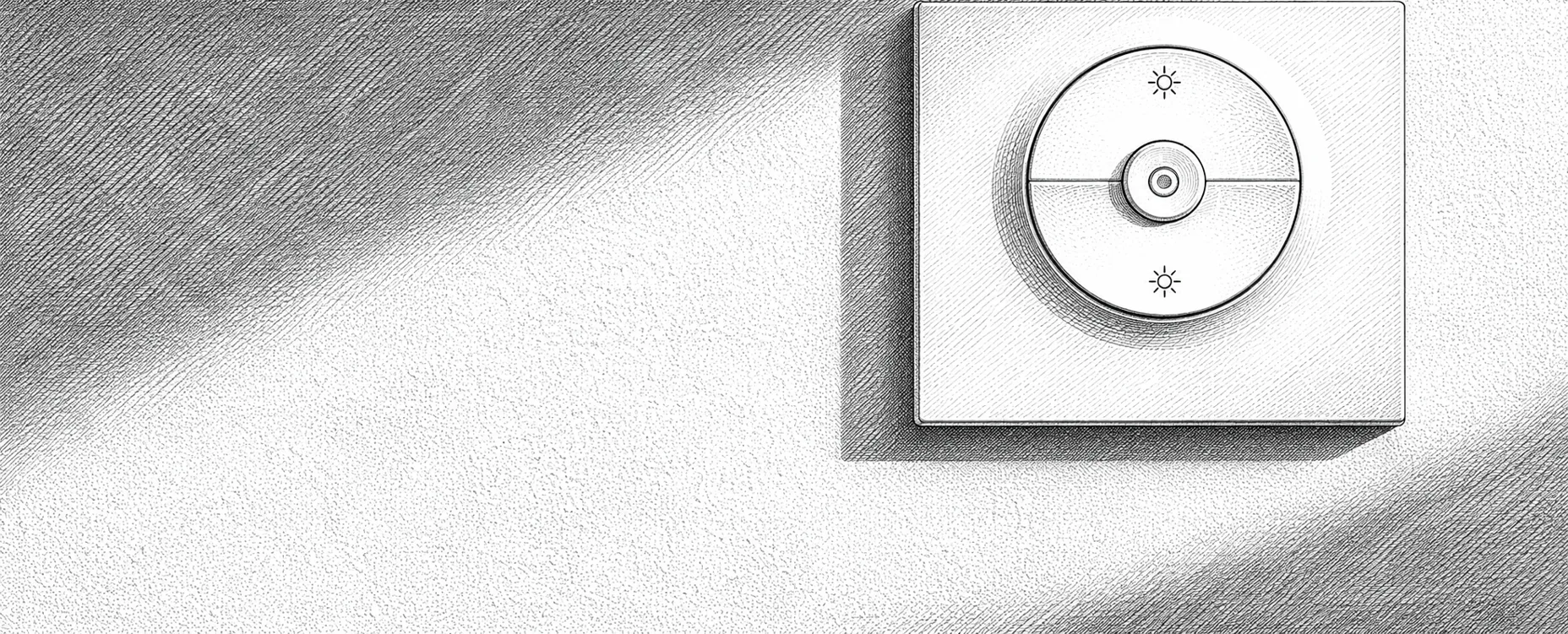
A smart switch replaces the physical switch on the wall. That is the whole appeal: the room keeps working exactly as everyone expects, a guest can turn the light on without an app, and the light stays reachable by automation because the switch never actually cuts power to a smart bulb. It is the grown-up answer to the problem that makes people give up on smart bulbs.
It is also the category where wiring decides everything. The critical question is whether your switch box contains a neutral wire — the return conductor that completes the circuit. Modern installations usually have one. Many older European boxes carry only live and switched-live, which means a smart switch has no way to power itself when the light is off. Some models work without a neutral by drawing a tiny trickle of current through the lamp, which works well with older bulbs and can cause faint flickering or glowing with low-power LEDs.
Two practical details catch people out. Several brands sell the switch mechanism without a faceplate, on the assumption you will reuse the existing one, so the advertised price is not the final price. And because these are mains-powered, Zigbee and Z-Wave models act as routers that strengthen your mesh — a genuine bonus of choosing switches over bulbs.
Open the existing switch and look. Three wires with a blue (neutral) present means you can use anything. Two wires means you need a specifically no-neutral model, and should expect to test for flicker with your particular bulbs.
A “gang” is one button position in a faceplate. A single-gang switch controls one light; two- and three-gang units control two or three from the same plate. Count what you are replacing before ordering.
Trailing edge (also called reverse phase) dimming suits almost all modern LEDs and is the setting to look for. Leading edge (forward phase) was designed for incandescent and halogen bulbs and can buzz or flicker with LEDs. Better switches let you choose.
Dimmers are rated in watts for the total lamp load, typically 120–600 W. LEDs draw so little that this is rarely a limit — but a very small load can be a problem, because some dimmers need a minimum wattage to regulate properly.
In Europe, plates follow brand systems such as JUNG or Busch-Jaeger. If you are replacing one switch in a room full of matching plates, check the model accepts them, or budget for replacing the lot.
Energy metering feeds your energy dashboard. A settable minimum brightness fixes bulbs that flicker at the bottom of the range. And on some models the physical terminals can be disconnected so the buttons become pure automation triggers rather than controlling the circuit directly.
| Brand | Model | Protocol | Dimmer | Works with no neutral | Metering | Indicative price |
|---|---|---|---|---|---|---|
| Shelly | Wall Switch (holder + module) | Wi-Fi | Yes | No | Yes | €7 + module |
| Sonoff | SwitchMan M5 | Matter over Wi-Fi | No | No | No | €18 |
| Zemismart | ZMS-206 Display Switch | Zigbee | No | No | No | €30 |
| ION Industries | LED Dimmer | Zigbee | Yes | In practice, usually | No | €39 |
| Aqara | Dimmer Switch H2 | Zigbee or Thread | Yes | Yes | Yes | €50 |
| KlikAanKlikUit | Rotary Dimmer MAWD-250 | Matter | Yes | Yes | No | €53 |
| Fibaro | Walli Dimmer | Z-Wave | Yes | Yes | Yes | €60 |
| Sunricher | Wall Dimmer | Zigbee or Z-Wave | Yes | No | Yes | €65 |
| EcoDim | LED Dimmer Switch | Z-Wave, Zigbee or Matter | Yes | Yes | Yes | €70 |
| Niko | Double Switch | Zigbee | No | No | No | €89 |
| Qubino | Luxy Smart Switch | Z-Wave | No | No | No | €99 |
Prices move constantly and vary by country, so we give an indicative band rather than a figure that would be stale within a month. Check the brand's own store for the current price.
This is the most capable switch here for the money, and the one to reach for in an older house. It works without a neutral wire, supports both dimming methods so it can be matched to awkward bulbs, and genuinely dims smoothly from 1% rather than jumping to 10%.
One important quirk: it is dual-protocol, and the Matter / Thread path exposes fewer settings than the Zigbee path — you lose the dial sensitivity and minimum/maximum brightness controls. If you need those, pair it over Zigbee.
The Walli is the reliable premium Z-Wave option, and unusually flexible about what it can dim. Press the top or bottom of the paddle to dim, and the coloured LED strip shows how much power the circuit is drawing.
If you are dimming a single low-wattage LED you will probably need the Fibaro Bypass 2, a small component wired at the fitting that gives a no-neutral dimmer enough current to behave. Budget for it rather than being surprised.
Dutch-built and the choice of a lot of installers, EcoDim ships the mechanism only, deliberately, so it disappears behind the plates already on your wall. That is a real advantage when you are retrofitting one switch in a room. It is available in Z-Wave, Zigbee and now Matter versions — note the Matter variant needs a Matter-capable hub rather than working through a bridge.
A genuinely useful hybrid: it speaks Matter to your hub while still accepting the old 433 MHz remotes many Dutch homes already have in a drawer. Three dimming modes — trailing edge, leading edge and a dedicated LED filament profile — make it one of the more adaptable dimmers for decorative bulbs, which are notoriously fussy.
Worth understanding what this actually is: not a smart switch, but a plate and button assembly designed to press a Shelly relay or dimmer module hidden in the box behind it. Add a Shelly 1PM, Plus 1PM, 1L or Dimmer 2 and you have a complete solution for very little money. It is the budget route, and the looks reflect that.
The cheapest way to put Matter switches throughout a house, provided your boxes have neutrals. Multi-way support means it handles the common case of two switches controlling one light. Restore-state and timed “inching” behaviour have to be configured in Sonoff’s own app first, after which your hub takes over.
A statement piece rather than a workhorse: a glass touch panel whose ambient backlight doubles as a night light and whose five zones can each trigger something different. Note the limitation buried in the specification — the light it is wired to can only be toggled, not dimmed, which is an odd omission at this price.
There are three ways to make a light switch smart, and the right answer depends on whether you care how the wall looks.
A smart wall switch replaces the visible switch. Best appearance, but you are committed to that brand’s design language in every room you do it.
An in-wall module (a relay or dimmer hidden in the box) keeps your existing switch and plate entirely. Nothing changes visually, which is ideal in a period property or a rental you cannot alter. It needs space in the box, which older shallow boxes may not have.
A wireless battery button replaces the switch mechanism with something that only sends signals. Nothing is wired, so it can go anywhere — including where there was never a switch — but the circuit is then permanently live, which is exactly what smart bulbs want.
Turn off the circuit at the breaker, unscrew the existing switch and count the conductors. Live and switched-live only (commonly two wires, often both brown or black) means no neutral. A third wire, usually blue in modern European wiring, is the neutral. If in any doubt, ask an electrician — guessing here risks damaging the switch or the bulbs.
Almost always because the dimmer works without a neutral and draws a small trickle of current through the lamp to power itself. Modern LEDs need so little power that this trickle is enough to make them glimmer. The fix is a bypass component fitted at the light (Fibaro sells the Bypass 2 for this), a higher combined lamp wattage, or a dimmer that has a neutral connection.
Both work by cutting part of the alternating-current waveform, but at opposite ends. Leading edge (forward phase) was designed for incandescent and halogen lamps and often buzzes with LEDs. Trailing edge (reverse phase) is smoother and quieter and is what you want for almost all modern LED lighting.
Zigbee and Z-Wave ones do. Because they are permanently mains powered, they act as routers that relay traffic for battery-powered sensors, extending range and reliability. Wi-Fi and Matter-over-Wi-Fi switches do not contribute to a mesh.
For any room with more than one or two fittings, usually yes — one switch controls the whole circuit for less than the cost of five bulbs, and the room still works by hand. Bulbs win where you want colour, or where you cannot or may not alter the wiring.
More terms in the smart home glossary. Related questions: What is the difference between a smart plug, a switch module and a smart bulb? Should I buy smart bulbs or smart switches?