Best Buys › Energy Storage Systems
Energy Storage Systems
Home batteries — and the inverter question that quietly decides which ones you can even buy.
Best Buys › Energy Storage Systems
Home batteries — and the inverter question that quietly decides which ones you can even buy.
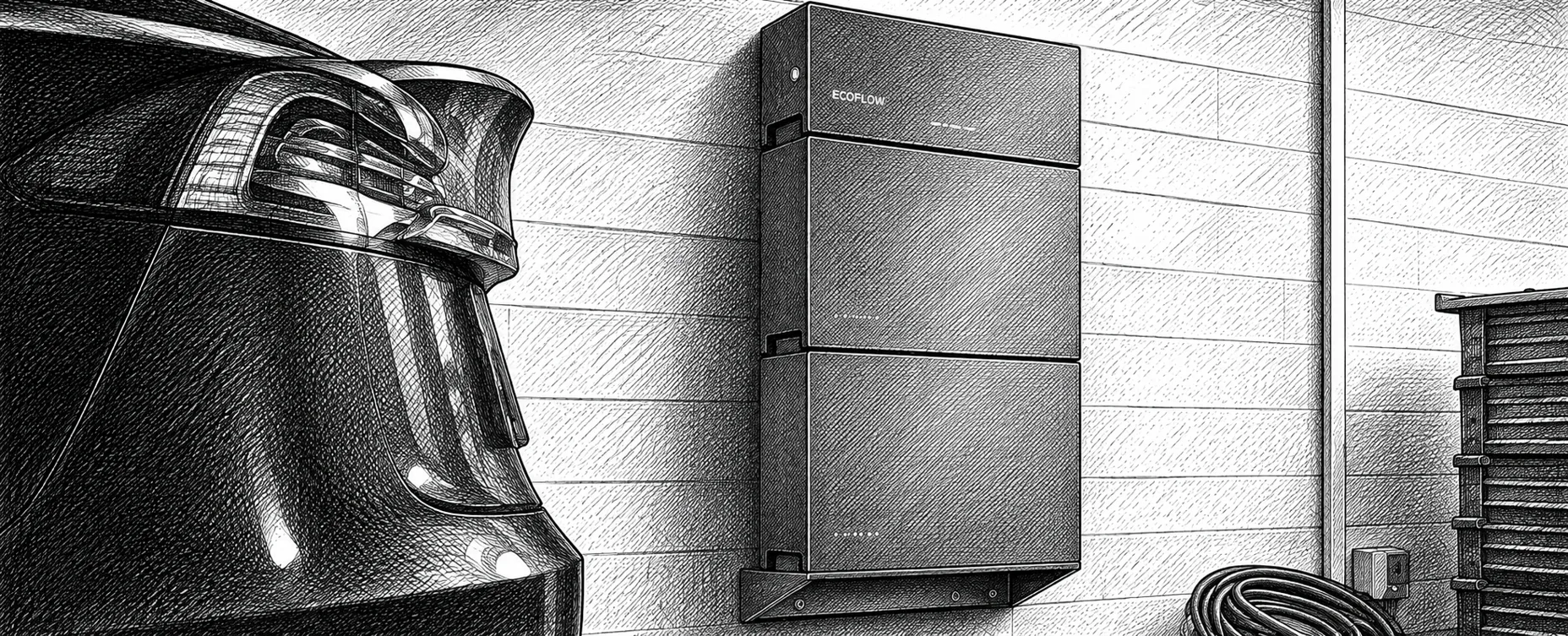
A home battery does three things, and it is worth being clear which one you actually want. It stores your own solar generation for use after dark, which raises self-consumption. It buys electricity when it is cheap and uses it when it is expensive, which pays regardless of whether you have panels. And on some systems it keeps the lights on during a power cut — but only on some, and that capability is often assumed rather than confirmed.
The decision that constrains everything else is the inverter. An inverter converts the direct current (DC) that panels and batteries produce into the alternating current (AC) your house uses. Several manufacturers — Fronius, Growatt and SMA among them — only sell batteries that work with their own inverters, so if you already have solar, your existing inverter may rule out most of the market before you start comparing capacities.
The way around that is an AC-coupled battery, which contains its own inverter and connects on the household AC side. It works with essentially any existing solar setup, at the cost of one extra conversion step and slightly lower round-trip efficiency. Sonnen and EcoFlow’s DC Fit retrofit are the notable inverter-agnostic options here.
If you already have solar, find out which inverter you have before anything else. Fronius, Growatt and SMA batteries only pair with their own brand. An AC-coupled battery avoids the issue entirely and works with almost anything.
Capacity is measured in kilowatt-hours. A typical household evening uses 5–10 kWh, so that is a sensible starting point. More useful than the initial figure is whether you can add modules later, because your consumption will change.
Capacity is how much is stored; output is how fast it can be delivered. A large battery with modest output cannot run an induction hob, a kettle and a heat pump simultaneously. Check the continuous kW figure against your realistic peak.
Battery wear is counted in charge cycles — one full charge and discharge. Warranties here run from 6,000 to 10,000 cycles. At roughly one cycle a day, 6,000 cycles is about sixteen years, so this is less limiting than it sounds, but it is the honest basis for comparing longevity.
Running your house from the battery while disconnected from the grid is called island mode or off-grid capability, and it needs specific hardware. Several batteries explicitly cannot do it and require a permanent grid connection — so if outage protection is why you are buying, verify it in writing.
IP20 means indoor only. IP65 allows outdoor installation. Batteries are heavy, and a garage or utility wall usually needs checking for load-bearing capacity as well as ventilation and temperature range.
| Brand | Model | Capacity | Inverter | Cycles | IP rating | Approx. per kWh |
|---|---|---|---|---|---|---|
| SolarEdge | Home Battery | 10–30 kWh | SolarEdge only | 10,000 | IP65 | €600 |
| SMA | Energy Home Storage | 3.2–16.4 kWh | SMA hybrid only | 8,000 | IP65 | €625 |
| Sessy | Home Battery | 5–30 kWh | Any, or standalone | 6,000 | IP20 | €650 |
| Growatt | ARK Battery | 7.5–25 kWh | Growatt only | 6,000 | IP65 | €500 |
| Homevolt | Battery | 6.6 or 13.3 kWh | Built in | 6,000 | IP65 | €750 |
| Sonnen | Batterie 10 | 5.5–22 kWh | AC-coupled, any | 10,000 | IP56 | €800 |
| Fronius | Solar Battery | 4.5–12 kWh | Fronius only | 8,000 | IP20 | €1,100 |
| EcoFlow | PowerOcean | 5–45 kWh | Built in, or DC Fit retrofit | 6,000 | IP65 | €1,200 |
Prices move constantly and vary by country, so we give an indicative band rather than a figure that would be stale within a month. Check the brand's own store for the current price.
The most flexible option here, and the standout if you do not have solar panels. Because it can operate standalone on a dynamic tariff — charging at 3am when prices are low, discharging during the evening peak — it pays for itself on price differences alone. That is increasingly the main reason Dutch households buy a battery at all.
The practical caveat is installation: units do not stack, and each needs its own wiring run, so a 20 kWh system is four separate installations rather than one. Budget accordingly and expect a professional installer.
The retrofit answer. Being AC-coupled means it brings its own inverter and connects on the household AC side, so your existing panels and inverter — whatever brand — do not need replacing. For anyone who installed solar five years ago and now wants storage, that removes the single biggest obstacle.
It also genuinely does backup, which several rivals do not, and the 10,000-cycle warranty is at the top of the field. You pay handsomely for all of this, but it is the least compromised system on the list.
If you already have SolarEdge solar, this is close to a default choice: excellent cycle life, generous scaling, outdoor rated, and good software control. Two variants exist — a 400 V single-phase battery for Home Hub and HD-Wave inverters, and a 48 V DC three-phase battery for the Home Short String inverter — so check which matches your installation before ordering.
The budget option, and by a clear margin on price per kilowatt-hour. Modular 2.5 kWh packs make the sizing granular once you are past the three-pack minimum. The constraint is the ecosystem — Growatt inverters only — so this is a choice you make when specifying a whole new solar system rather than a retrofit.
German engineering with a long track record, and the small 3.2 kWh entry point is unusually sensible — it lets you start modestly and add capacity once you understand your own consumption pattern, rather than guessing at 10 kWh on day one. Requires an SMA Sunny Boy Smart Energy or Sunny Tripower Smart Energy hybrid inverter, meaning one unit handles both panels and battery.
Two products worth separating. The standard PowerOcean includes a hybrid inverter — a single unit managing both solar input and battery charge and discharge — making it a complete new installation. The DC Fit version is the interesting one: it adds storage to an existing solar array without replacing the inverter you already own, which is a genuinely useful middle path between AC-coupling and a full rebuild.
A tidy all-in-one with genuinely clever software: it trades your stored energy against hourly wholesale prices, buying low and discharging high without you managing anything. For a household on a dynamic tariff, that automation is the whole value proposition.
One limitation to be very clear about, because it is the opposite of what most people assume a battery does: there is no island mode. It requires a permanent grid connection and will not power your house during an outage. If backup is your reason for buying, this is not the product.
Well built, with LiFePO₄ (lithium iron phosphate) cells — the chemistry that trades a little energy density for markedly better safety and cycle life, which is the right trade in a building. The constraints are real though: it works only with Fronius Primo, Symo and GEN24 Plus inverters, and IP20 means it cannot be installed outdoors at all, so you need suitable indoor space.
Sometimes, and the answer depends far more on your tariff and country than on the hardware.
Where it usually does. If you are on a dynamic hourly tariff, the daily spread between the cheapest and most expensive hours is often large enough that charging at night and discharging at the evening peak pays a real return — with no solar panels required. If your country has ended or is phasing out net metering (the arrangement where exported solar is credited at the same rate you pay for imports, as the Netherlands is changing), storing your own generation suddenly becomes far more valuable than exporting it.
Where it usually does not. On a flat tariff with generous net metering still in place, there is little to arbitrage and little reason to store. In that situation a battery is buying resilience and independence rather than savings, which is a legitimate purchase — just not a financial one.
Two figures to ask any installer for: the round-trip efficiency, which is the percentage of energy you get back out after storing it (typically 85–95%, and the losses are real money), and the usable capacity as opposed to the nominal figure, since most systems deliberately hold a reserve.
It depends on the battery. Fronius, Growatt, SMA and SolarEdge batteries only work with their own brand of inverter, so an existing installation may rule them out. AC-coupled batteries such as the Sonnen Batterie 10 include their own inverter and connect on the household AC side, so they work with essentially any existing system. EcoFlow’s PowerOcean DC Fit is a middle path that retrofits without replacing your inverter.
Start from your evening consumption, which is what a battery covers. Most households use 5–10 kWh between sunset and bedtime, so that is a sensible first target. Measure before you buy — an energy meter costing €30 will tell you your real pattern, and oversizing a battery is an expensive way to guess.
Only if it supports island mode, and several do not. Homevolt explicitly cannot — it requires a permanent grid connection. Sonnen and SolarEdge are backup-capable. If outage protection is your reason for buying, get it confirmed in writing, because it also requires specific installation work beyond the battery itself.
One cycle is a full charge and discharge. Warranties here run from 6,000 to 10,000 cycles; at roughly one cycle a day, 6,000 cycles is about sixteen years. In practice batteries lose capacity gradually rather than failing outright, so warranties usually guarantee a percentage of original capacity remaining at the end of the term.
A DC-coupled battery connects on the direct-current side, sharing an inverter with the solar panels — more efficient, but it ties you to compatible inverters. An AC-coupled battery has its own inverter and connects on the household alternating-current side — slightly less efficient because of the extra conversion, but compatible with almost any existing solar installation.
More terms in the smart home glossary. Related questions: Does my solar inverter matter for smart home automation?